Browse Abandonment Flows in Klaviyo: The Flow Everyone Skips (And Shouldn't)
Most brands look at their browse abandonment metrics, see a lower conversion rate than cart or checkout, and decide it's not worth the effort.
That's the wrong way to read the data.
Browse abandonment is consistently a top-5 revenue generating flow — sometimes top 3. It normally falls behind welcome, checkout, and cart abandon, but it can compete with cart. The reason: even though the per-email conversion is lower, the volume is dramatically higher. Way more people view a product than add to cart. So even with a weaker conversion rate, the total revenue hits hard.
The gap is real and worth sizing. Across the 14 brands in our per-flow benchmark data, browse abandonment converts at a 0.61% median on the entry email against 1.82% for abandoned cart — roughly a third of the rate, at $0.92 revenue per recipient against cart's $3.56.
The per-email metrics don't look impressive, which is exactly why brands deprioritize it. But total revenue from volume? That's the number that matters. We've seen browse abandon compete with cart abandon on total revenue for brands that have it set up correctly. The ones that skip it are leaving real money on the table — not because each email crushes it, but because the audience is massive.
The Flow: 2 Emails, Nothing Fancy
Trigger: Viewed Product
Flow Filters (AND logic — more on this in a second):
- Has NOT added to cart since starting this flow
- Has NOT started checkout since starting this flow
- Has NOT placed order since starting this flow
Trigger Filter: Has not placed order in the last 10 days
Re-entry: 14-21 days
Smart Sending: Off. Browse abandonment earns its keep on volume — silent Smart Sending suppression eats directly into that volume. See Klaviyo Smart Sending: Turn It Off in Flows.
That trigger filter deserves a callout. We found a client whose site abandonment flow was firing on people who had just purchased. Someone places an order, gets the "your order's shipped, check your tracking" email, clicks through to the website, and boom — site abandonment flow triggers. Same thing happens with browse abandon if you don't exclude recent purchasers. Add "has not placed order in the last 10 days" as a trigger filter, not just a flow filter. Trigger filters prevent people from entering. Flow filters skip people after they've entered. You want to stop this at the door.
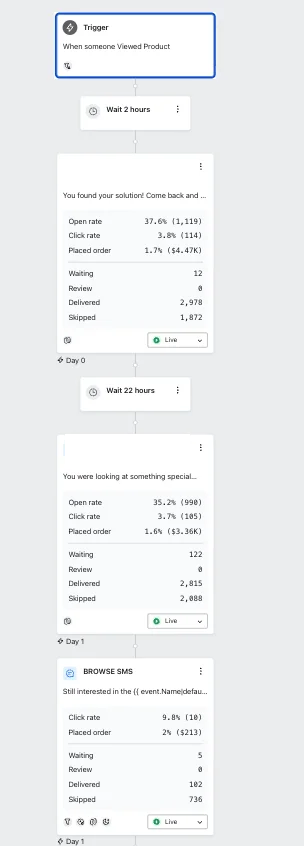
Browse flow: Viewed Product → 2-hour delay → 2 emails + SMS
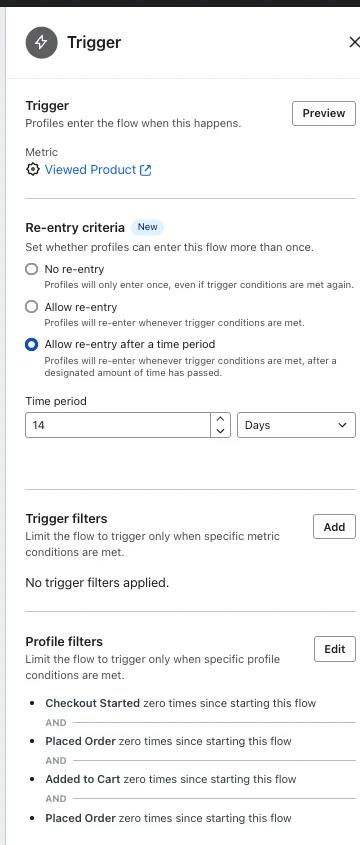
Trigger detail: AND filters excluding higher-intent actions
Email 1: What They Were Viewing + Policy Highlights
Send after a 1-4 hour delay. Show the specific products they viewed using Klaviyo's dynamic product blocks — the actual items, not best sellers. Pair it with friction-reducing callouts: free shipping, easy returns, whatever makes buying feel safe. This isn't a hard sell. It's a reminder.
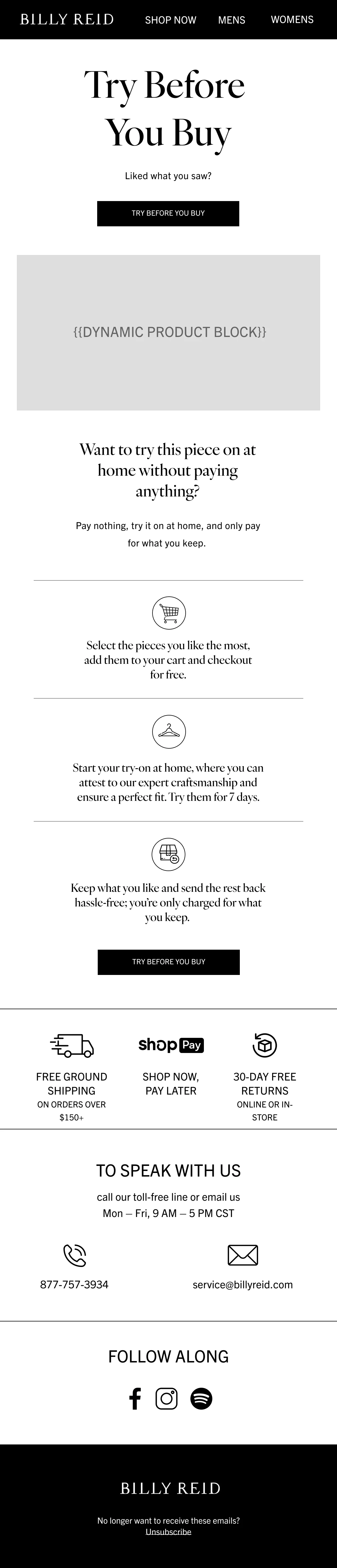
Billy Reid (luxury menswear). Instead of a discount, leans on the TryNow program — pay nothing, try it at home, only pay for what you keep. Dynamic product block up top, program mechanics in the middle, shipping/returns/Shop Pay at the bottom.
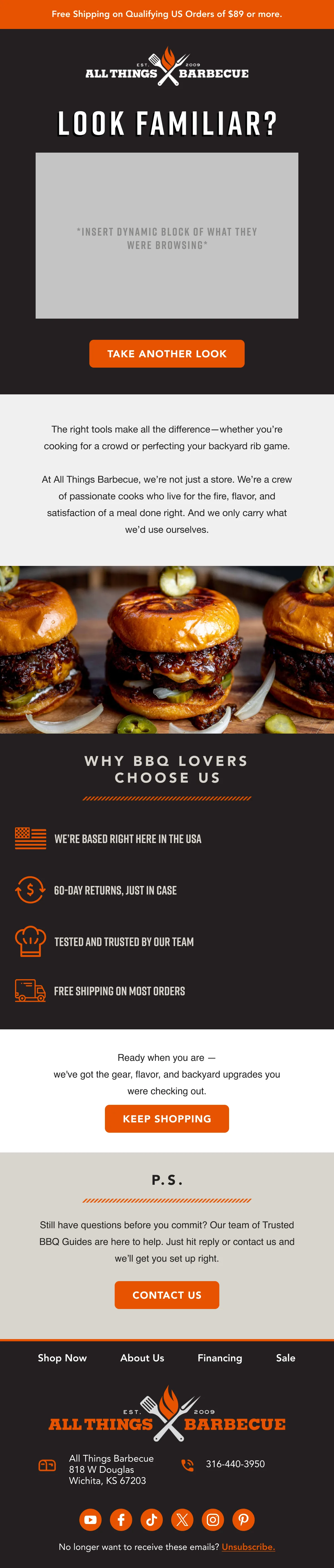
All Things BBQ (BBQ + lifestyle). "Look Familiar?" with the viewed-product block, a short brand-story beat ("a crew of passionate cooks who live for fire, flavor, and satisfaction of a meal done right"), then a four-icon trust block — USA-based, 60-day returns, free shipping.
Notice what neither email has: a discount code. Browse is the top of the abandonment funnel — these people haven't even added to cart yet. Training them to expect a coupon for looking at a product page is the fastest way to build a customer base that waits instead of buys.
Email 2: Same Products + Similar Recommendations + Reviews
Delay: 2 days after Email 1. They didn't bite on the reminder. Expand the options. Show the same products but add similar recommendations — maybe the original wasn't quite right on color, size, or price. Add reviews on the products they viewed. Real people saying real things about items this person already showed interest in. That's more persuasive than a generic "our customers love us" block.
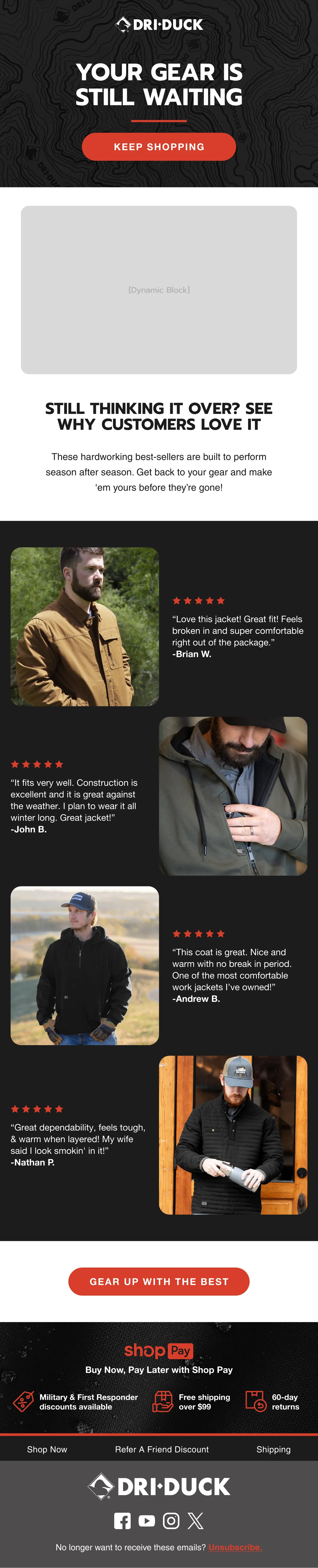
Dri Duck (workwear). "Your Gear Is Still Waiting" with the product block up top, then four named-customer reviews with five-star ratings. The reviews do the heavy lifting — one data point is a data point, four is a pattern.
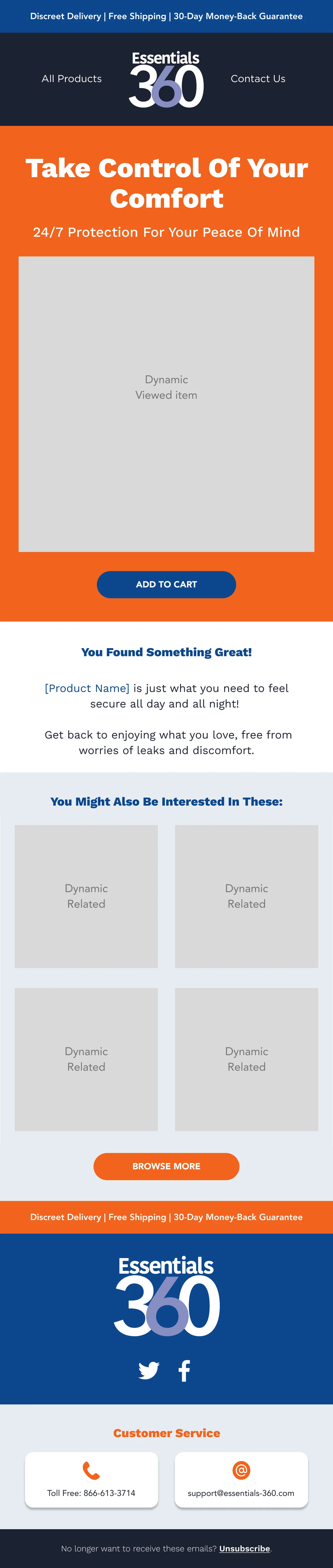
Essentials 360 (wellness). "Take Control Of Your Comfort" leads with the viewed item and an ADD TO CART button, then drops a 2x2 "You Might Also Be Interested In These" grid underneath. If the first product wasn't the fit, four alternatives are already on the page.
One more thing: link to the products, not your homepage. We've audited accounts where every CTA in the browse abandon flow points to the homepage. Your homepage is your worst converting page. You already know what they were looking at — send them back there.
The OR vs. AND Mistake That Breaks Everything
This is the section that matters most in this entire post.
We audited a food brand whose browse abandonment flow had all the right exclusion filters — has not added to cart, has not started checkout, has not placed order. Looked correct at a glance. But the filters were connected with OR instead of AND.
Here's why that's a disaster.
With OR logic, the filter says: "if they pass any of these conditions, let them through." So someone who added to cart fails the "has not added to cart" condition — but they pass the "has not started checkout" and "has not placed order" conditions. Two out of three is enough. They get through. Now they're receiving both the browse abandon AND the cart abandon flow. Wrong message, duplicate emails, confused customer.
With AND logic, the filter says: "they have to pass all of these conditions." Added to cart? Fail. Done. Flow skips them. They get picked up by the cart abandon flow instead, which is exactly where they belong.
The rule is simple: every time you're filtering with "zero times," it needs to be AND.
The downstream mess from OR logic is ugly. This same brand had a mess of cross-flow exclusions — manually excluding people who received emails from other flows — because the OR statements meant people were leaking into the wrong flows everywhere. They were trying to patch the problem by adding more exclusions on top of broken logic. It made the account nearly impossible to audit because nobody could tell what was actually happening.
Fix the AND logic and you don't need any of that. Your filters properly exclude higher-intent actions, and each flow only catches the people it's supposed to catch. No cross-flow exclusions needed. No patching. Just clean filter logic that does its job.
Browse vs. Cart vs. Site: What's Different
Browse abandon doesn't exist in a vacuum. Here's how the three abandonment flows compare:
| Site Abandon | Browse Abandon | Cart Abandon | |
|---|---|---|---|
| Trigger | Active on Site | Viewed Product | Added to Cart |
| Intent Level | Lowest | Medium | Highest |
| What You Know | They visited | They viewed specific products | They added specific items |
| Content | Best sellers, brand story | Products viewed + similar items | Cart items + objection handling |
| Emails | 2 | 2 | 3 |
| Re-entry Window | 21 days | 14-21 days | 7 days |
| Exclusion Filters | Viewed product, added to cart, checkout, purchase | Added to cart, checkout, purchase | Checkout, purchase |
The re-entry windows are intentional. You get tighter on your timeframes the lower you go in the funnel because the lower you go, the higher the intent is. Someone who browsed 2 weeks ago might still be interested — they were just looking, they haven't committed to anything. Someone who abandoned checkout 2 weeks ago? They've either bought it elsewhere or moved on. That's why checkout gets a 7-day window max and browse gets 14-21 days.
Each flow level filters out every higher-intent action. If someone viewed a product, added to cart, and started checkout, they only get the checkout abandon flow. Not all three. The exclusion filters handle the prioritization — as long as you're using AND logic.
Don't Discount This Flow
One thing worth saying explicitly: do not add a discount to browse abandon.
These people haven't even added anything to cart. If you train them to expect a coupon for looking at a product page, you're creating a customer base that browses and waits. Save discounts for checkout abandon or winback, where there's real purchase intent to recover. And when you do run them there, size them deliberately: our discount margin calculator shows the extra volume a given code depth needs before it pays for itself.
What to Do Next
Browse abandon is one piece of a larger flow system. If you're building this out:
- Complete Guide to Klaviyo Flows for the full flow map and how everything connects
- Abandoned Cart Flow Deep-Dive for the next flow up the intent ladder
- Flow Builder Tool to scope out which flows your brand actually needs
Want help building these?
We build these flows every week and we'll tell you straight up what's working and what's not.