Klaviyo SMS Marketing: Is It Worth It? Honest Review (2026)
Last Updated: February 2026
We manage Klaviyo SMS marketing across multiple ecommerce brands. We've also managed accounts on Attentive, Postscript, and Yotpo SMSBump.
This is our honest take on Klaviyo SMS marketing — what it does well, what could be better, how pricing works, and whether it makes sense for your brand.
Short answer: If you're already using Klaviyo for email, use Klaviyo for SMS. There's almost no scenario where a dedicated SMS platform makes sense if Klaviyo is your email provider.
What Klaviyo SMS Actually Does
Klaviyo built SMS on top of their existing email marketing platform. That's the key differentiator. Everything you already use for email — flows, segments, campaigns, analytics — works with SMS too.
In practice, this means:
- Flows can mix email and SMS. Your abandoned cart flow can send an email first, then follow up with an SMS if the customer doesn't convert. Same flow, same triggers, same filters.
- Segments are shared. Any segment you build for email — repeat buyers, VIPs, lapsed customers — automatically works for SMS targeting too. No duplicate audience building.
- One dashboard for everything. Revenue attribution, deliverability, subscriber growth — email and SMS reporting in the same place. No cross-referencing two platforms.
- Shopify data flows in natively. Purchase history, browse behavior, cart data — all available for SMS personalization and triggers, just like email.
Dedicated SMS platforms like Attentive and Postscript build their own versions of flows, segments, and campaigns. But they're rebuilding what Klaviyo already has — and the integration between their SMS tools and your email platform is never as tight as Klaviyo's native connection.
Here's what "same flow, same triggers" actually looks like — a production flow we run for one of our clients that branches between multiple email and SMS messages off a single trigger. This is one flow in one canvas, not two separate tools duct-taped together.
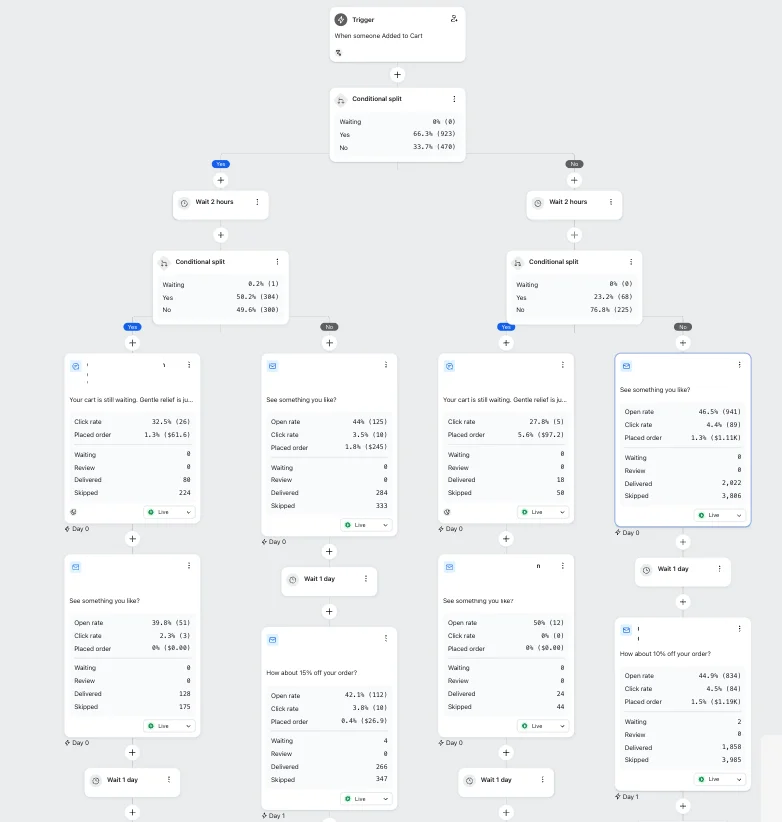
Zoomed out to fit the whole sequence in frame. The point isn't the individual nodes — it's that the email and SMS logic share one canvas, one set of filters, and one attribution report. A dedicated SMS tool forces you to rebuild everything on the right side of this picture in a separate system.
Klaviyo SMS Pricing: How Credits Work
Klaviyo SMS uses a credit-based pricing model. Here's how it breaks down:
- 1 SMS credit = 160 characters. Go over 160 characters and you're using 2 credits per message.
- Images (MMS) cost more. Adding a product image turns your SMS into an MMS, which uses additional credits.
- Emojis cost more too. Emojis use Unicode encoding, which reduces the character limit per segment — meaning your 160-character message might become a 2-credit message because you added an emoji.
- Volume discounts. Per-credit cost decreases as you buy more. Pricing is tiered and transparent — it gets cheaper at scale.
For current pricing tiers, check Klaviyo's pricing page directly — they use a calculator that adjusts based on your list size and message volume.
Pricing-wise, Klaviyo SMS is competitive with Attentive, Postscript, and SMSBump. They're all roughly in the same range — credit-based, volume-discounted. The per-credit cost difference between platforms is marginal. The real savings come from not paying for a second platform and not spending operational hours managing two systems.
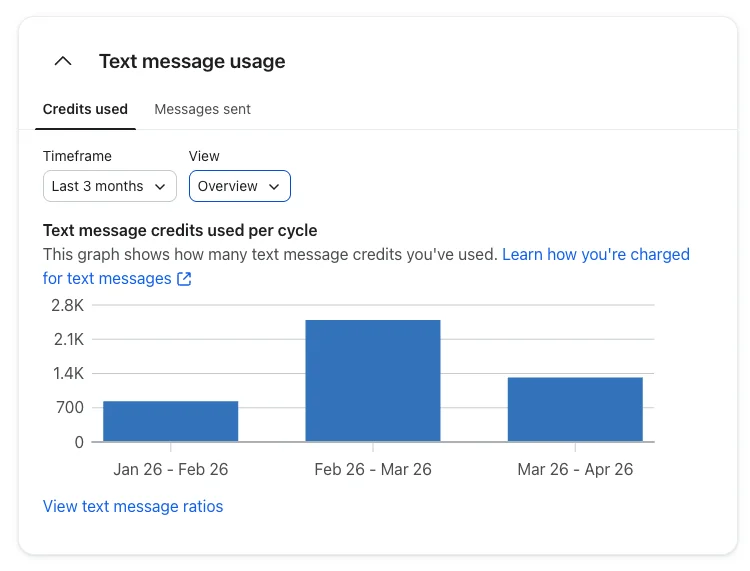
Once you're sending, the credit usage view in Klaviyo is what you'll actually watch to manage the bill. Campaigns and flow sends both draw from the same credit pool, and a single big promo can double or triple a month's spend — like this client's February, which ran close to 3x January:
SMS has a real cost — track your ROI
Email is essentially free per send — you pay for your list size, not per email. SMS is different. Every message costs credits. If you're spending $500/month on SMS but only generating $400 in attributed revenue, you have a problem. Track your SMS ROI monthly and adjust your targeting if the numbers don't work.
The cheapest place to grow the SMS list is the email list you already have. A popup targeted only at existing email subscribers who have not opted into SMS converts at 5.09% across four brands in our portfolio, roughly four times a standard on-site signup popup. Here is the setup and the numbers.
Setting Up Klaviyo SMS on Shopify
Klaviyo SMS setup on Shopify is straightforward, but there are things brands miss.
Provision sending countries first
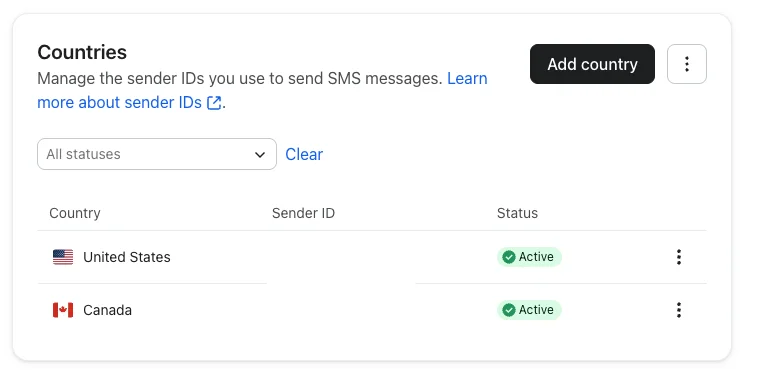
Before anything else: go to Account → SMS settings → Countries and add every country you plan to send to. Each country has to be provisioned individually and flip to Active status before it can receive messages. Sending to US customers? Add US. Shipping to Canada? Add Canada too. Skipping this is the single most common reason a brand's first SMS campaign doesn't deliver.
Collect SMS consent in two places
Most brands only collect SMS opt-ins on their popup form. You need it in both places:
- Your signup popup. Add a phone number field (or a separate SMS step) to your email popup. This catches new visitors.
- Shopify checkout. Enable SMS marketing consent in your Shopify checkout settings. This captures phone numbers from buyers — which is where most of your SMS list actually comes from.
If you only collect on the popup, you're missing checkout subscribers. If you only collect at checkout, you can't send pre-purchase SMS. You need both.
TCPA compliance basics
SMS marketing in the US falls under the Telephone Consumer Protection Act (TCPA). The essentials:
- Explicit consent required. You need clear opt-in before sending marketing SMS. Klaviyo handles the consent language in their built-in forms.
- Easy opt-out. Every SMS must include a way to unsubscribe. Klaviyo adds “Reply STOP to unsubscribe” automatically.
- Quiet hours. Don't send SMS before 8am or after 9pm in the recipient's time zone. Klaviyo enforces this by default — but check your settings if you're scheduling campaigns near those boundaries.
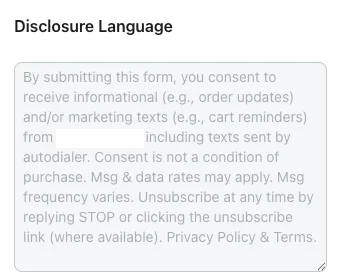
Here's the actual disclosure language we use on a client's SMS opt-in form. Klaviyo auto-appends "Msg & data rates may apply. Reply STOP to unsubscribe" on every send, but you still need to wrap the checkbox itself with explicit consent copy that names your brand, covers marketing vs transactional, and notes autodialer use:
Integrate SMS into your flows
Once SMS is enabled, add it to your existing Klaviyo flows. The ones that benefit most:
- Abandoned cart / abandoned checkout — SMS follow-up after the email doesn't convert
- Shipping notifications — order confirmed, shipped, delivered
- Welcome flow — a quick SMS after signup reinforces the relationship
- Winback — SMS for lapsed customers who haven't responded to email
The simplest one to build first is an "Email Subscribers to SMS" welcome flow — converting people who already gave you email into SMS subscribers. Three messages over four days works well: welcome + intro offer, friendly reminder, last-call urgency. Here's how it looks in the Klaviyo flow builder:
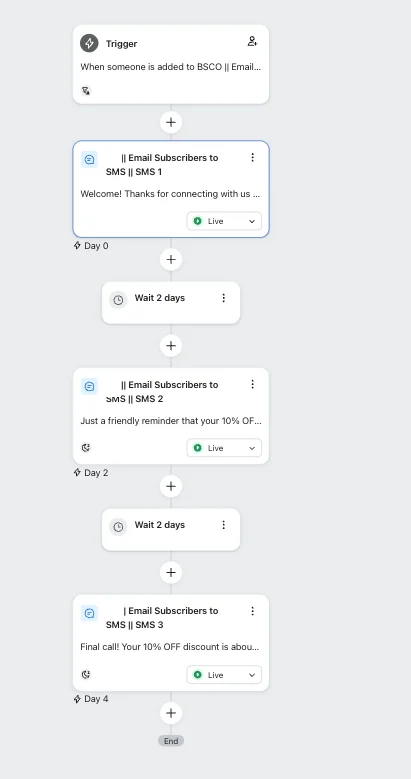
This is the same flow builder you're already using for email — same trigger logic, same wait blocks, same filters. Notice the "Live" status on every step: a dead SMS flow is silent, not broken, so always confirm every message is actually set to Live before walking away.
For copy-paste templates for each of these flows, see our SMS marketing templates guide.
When Klaviyo SMS Makes Sense (and When It Doesn't)
Use Klaviyo SMS if you're using Klaviyo for email. Klaviyo already has the flow builder, the segmentation engine, the campaign tools, and the Shopify integration. SMS is built on top of all of that. Everything the dedicated SMS platforms do — flows, audiences, campaigns — Klaviyo already does for email and has extended to SMS.
There is functionally nothing that Attentive, Postscript, or SMSBump can do that Klaviyo SMS marketing can't. And Klaviyo does it with the advantage of native data — no syncing, no integration issues, no split reporting.
The only exception: you're not using Klaviyo for email. If your email is on Mailchimp, Omnisend, or another platform and you want to add SMS, then a standalone SMS tool like Postscript might work. But if you're serious about ecommerce retention marketing, we'd recommend migrating both email and SMS to Klaviyo. The consolidated platform is worth it.
Klaviyo SMS vs Attentive vs Postscript
Here's how Klaviyo SMS stacks up against the two most common dedicated SMS platforms:
| Feature | Klaviyo SMS | Attentive | Postscript |
|---|---|---|---|
| Email integration | Native (same platform) | Third-party sync | Third-party sync |
| Shared flows (email + SMS) | Yes | No (SMS-only flows) | No (SMS-only flows) |
| Shared segments | Yes | No (separate audiences) | No (separate audiences) |
| Pricing transparency | Public (calculator) | Sales call required | Public |
| Contract required | No | Annual contract | No |
| UX/UI polish | Functional, not flashy | More polished | Clean, simple |
| Best for | Klaviyo email users | Enterprise SMS teams | Shopify brands not on Klaviyo |
For detailed reviews: Attentive review · Postscript review · Yotpo SMSBump review
Common Klaviyo SMS Mistakes
1. Paying for it but not using it
The most common mistake we see. A brand enables Klaviyo SMS, adds it to their abandoned cart flow, and then never touches it again. No campaigns, no other flow integrations, no strategy.
If you're paying for SMS, you should be sending at least 1-2 SMS campaigns per month. You should have SMS integrated into all your major flows — not just abandoned cart but welcome, shipping, winback, and promotional flows.
2. Only collecting SMS on the popup
Your popup catches new visitors, but your Shopify checkout catches buyers. Most of your SMS list growth will come from checkout. Make sure SMS consent is enabled there too.
3. Not tracking SMS ROI
Unlike email, SMS has a real per-message cost. You need to be ROI-positive on your SMS spend. Check your Klaviyo SMS reports monthly — revenue attributed vs. credits spent. If a particular campaign or flow isn't generating positive returns, adjust your targeting or cut it.
4. Treating SMS like email
SMS is a notification channel, not a brand-building channel. Messages should be short (under 160 characters when possible), direct, and actionable. No paragraphs. No daily sends. Two to four SMS campaigns per month is plenty for most brands.
Our Rating: 4.5 / 5
What's great: Native email + SMS integration. Shared flows, segments, and data. No syncing issues. Credit-based pricing is transparent and competitive. Everything the dedicated SMS platforms do, Klaviyo SMS marketing does with better data.
What could be better: The UX/UI could use polish. Some users find the SMS composer less intuitive than Attentive's interface. If you care about aesthetics, Attentive looks nicer. If you care about functionality and results, Klaviyo wins.
Bottom line: There isn't a better SMS product on the market for ecommerce brands using Klaviyo. The integration advantage alone makes it the obvious choice. The only reason to look elsewhere is if you're not on Klaviyo for email.
Frequently Asked Questions
Is Klaviyo SMS worth it?
Yes, if you're already using Klaviyo for email. You get native integration with your flows, segments, and customer data — no third-party sync issues. If you're not on Klaviyo for email, there's no specific reason to choose Klaviyo SMS over other options.
How much does Klaviyo SMS cost?
Klaviyo SMS is credit-based. One credit covers 160 characters. Images and emojis cost additional credits. Pricing gets cheaper with volume. Check Klaviyo's pricing calculator for current rates at your list size.
Should I use Klaviyo SMS or Attentive?
If you're on Klaviyo for email, use Klaviyo SMS. Running a separate SMS platform creates data sync problems, inflated attribution, and unnecessary complexity. Read our full Attentive review for details.
Should I use Klaviyo SMS or Postscript?
Same answer. Postscript works fine as a standalone tool, but managing SMS in a separate platform means duplicate audiences, separate flows, and split reporting. Read our full Postscript review.
What's the biggest mistake brands make with Klaviyo SMS?
Paying for it but not using it. Turning on SMS, adding it to one flow, and never sending campaigns. If you're paying for SMS credits, you need to be actively sending — at least 1-2 campaigns per month and SMS in all your major flows.
Need help setting up Klaviyo SMS?
We set up and manage Klaviyo SMS for ecommerce brands. Flows, campaigns, compliance — the full stack.