Klaviyo Winback Flow: How to Re-Engage Lapsed Customers
Most brands either don't have a winback flow or they have one doing the wrong job. The confusion is simple: winback targets customers who bought from you but haven't come back. Sunset targets subscribers who never purchased and stopped engaging. Those are two completely different problems, and the flow that handles each one should be built differently.
The winback flow lives in the window between "lapsed" and "gone." Get the timing right and you bring people back. Get it wrong — or worse, don't have one at all — and you're bleeding customers into a suppression list who could've been saved.
The Winback Flow: 3 Emails That Do the Work
Here's the full technical setup for the winback flow we build for clients.
Trigger and Timing
- Trigger: Placed Order
- Initial delay: Based on your repurchase data (more on this below)
- Flow filters: Has placed 0 orders since starting this flow
Why trigger on Placed Order with a delay instead of building a segment? Because the delay starts from each customer's last purchase. It's personalized automatically. If someone bought in January and your delay is 75 days, their winback fires in March. A segment-based approach batches everyone together regardless of when they actually lapsed.
This matters because winback should be purchase-triggered, not engagement-triggered. We'll get into why below, but the short version: engagement-based logic creates more problems than it solves.
When you launch, test the delay with a 50/50 time delay split. You'll learn fast whether your audience responds better to an earlier or later touch.
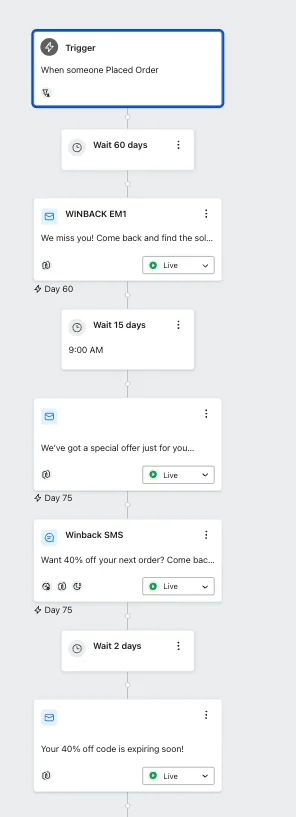
Winback flow: Placed Order → 60-day delay → 3-email sequence
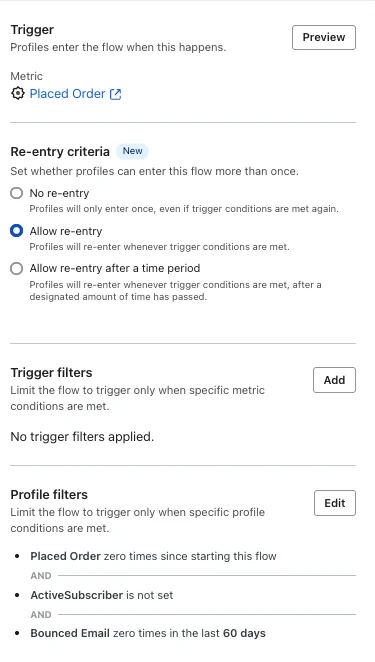
Trigger detail: AND filters + re-entry enabled
Email 1: "We Miss You" + New Arrivals
Delay after trigger: Immediate (after the initial delay)
Don't open with a discount. Open with what's new.
This email is a "here's what you've missed since your last order" message. Highlight new arrivals, new collections, anything that's changed. The subject line is something like "It's been a while" or "A lot has changed since your last order." The goal is re-engagement, not conversion. A lot of lapsed customers didn't leave because they had a bad experience — they just got busy, got distracted, or forgot. This email catches those people without training the entire segment to wait for discounts.
Email 2: Offer Open + Policy Reminder
Delay: 2 days after Email 1
Now you introduce the incentive. Pair the offer with a shipping and returns policy reminder. Someone who hasn't bought in months might not remember your shipping speed or return policy. Removing that uncertainty alongside the offer gives them fewer reasons to hesitate.
Email 3: Offer Close + Reviews + Customer Support
Delay: 2 days after Email 2
Close the offer with urgency. Add social proof — recent customer reviews that address common objections. And include a customer support angle: "Need help finding something? Reply to this email." Some lapsed customers want to come back but don't know where to start, especially if your catalog has changed. Making it easy to ask for help converts people who would otherwise bounce.
Three Winback Flows, Three Strategies
The framework above is a starting point, not a rule. Here are three brands we work with running winback in three different rhythms — same 3-email cadence, same goal, very different approaches. The one that fits your brand depends on your margin structure, your AOV, and how aggressively your lapsed segment responds to offers.
Essentials 360: The Classic Framework
Miss you → offer open → offer close. This is the textbook version. Email 1 leans on best-seller reviews with no discount, Email 2 drops a 40% subscription offer with 2-day urgency, Email 3 hammers "12 hours left." Works well for wellness, subscription, and consumables where margin supports a meaningful discount and subscription LTV justifies the margin hit. Before borrowing the 40% number, run it through our discount margin calculator to see the sales lift an offer that deep requires at your COGS.
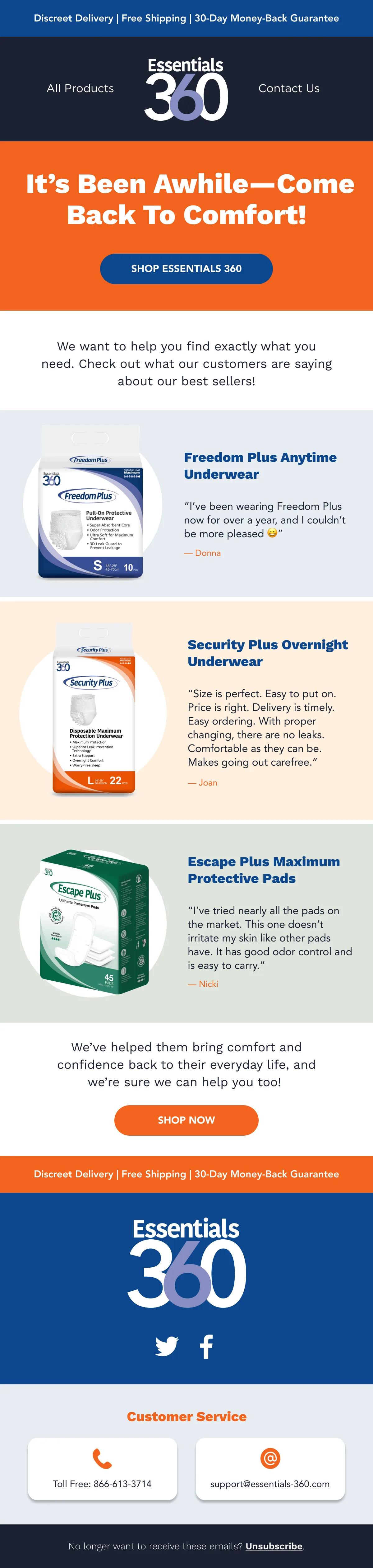
Email 1: Reviews, no discount
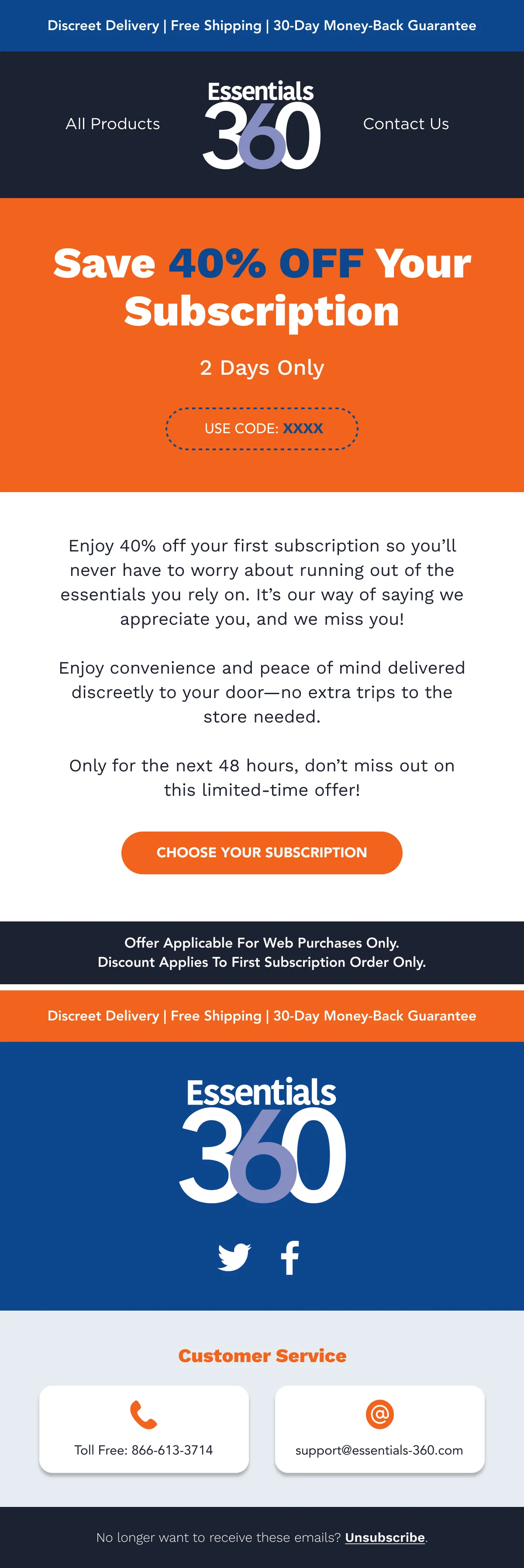
Email 2: Offer open (40% off)
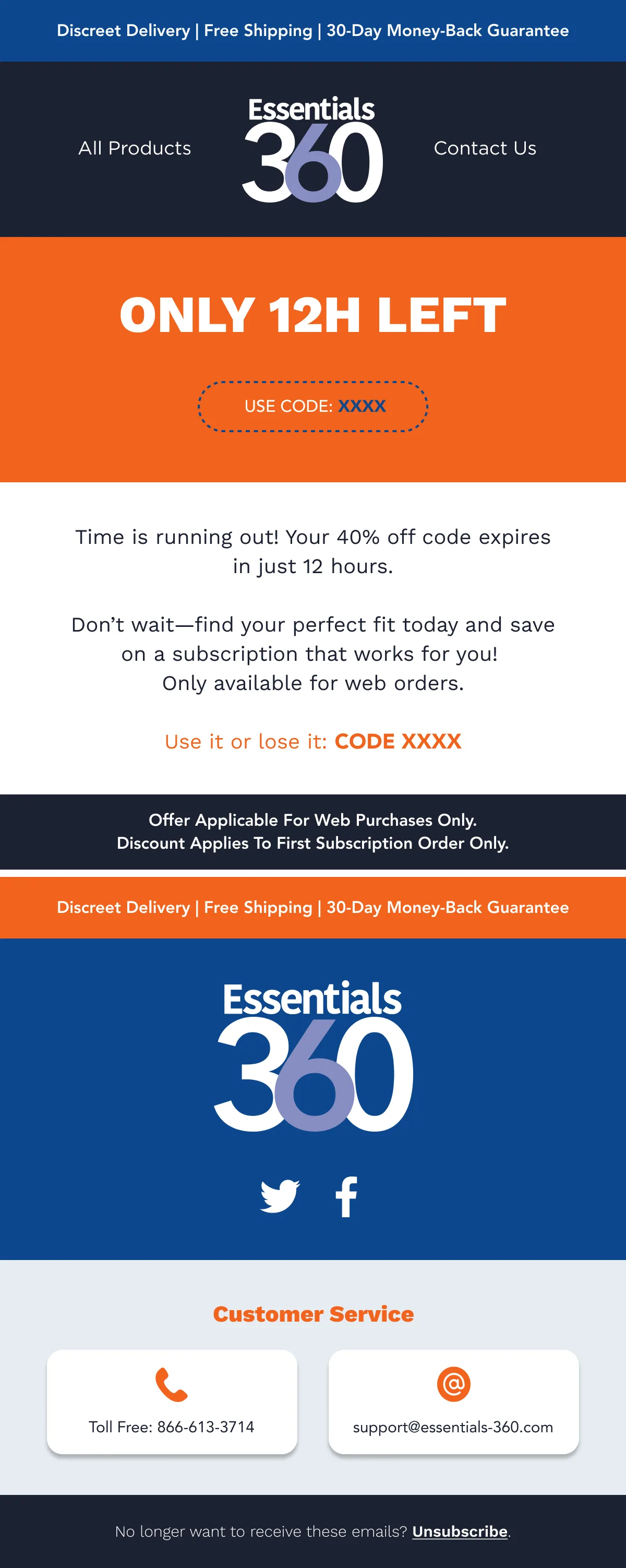
Email 3: 12-hour closer
All Things BBQ: Soft + Value + Offer
Same 3-email structure, but the first two emails earn the right to pitch before any money gets discussed. Email 1 pushes the rewards program instead of a discount. Email 2 is pure value — "5 Quick Tips for Better BBQ" — content a lapsed customer would actually want to read. Only on Email 3 does a $25 off $100+ offer land with 48-hour urgency. Works well for brands where the community and expertise ARE the product — where leading with a discount would feel cheap.
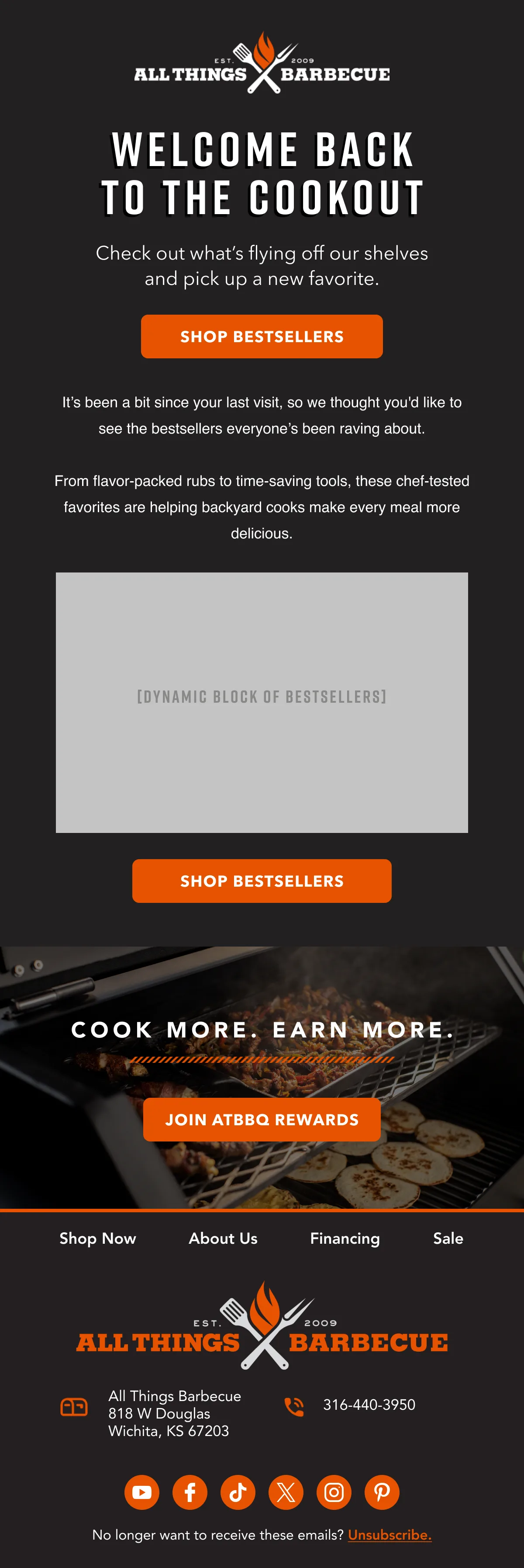
Email 1: Bestsellers + rewards

Email 2: Tips + value content
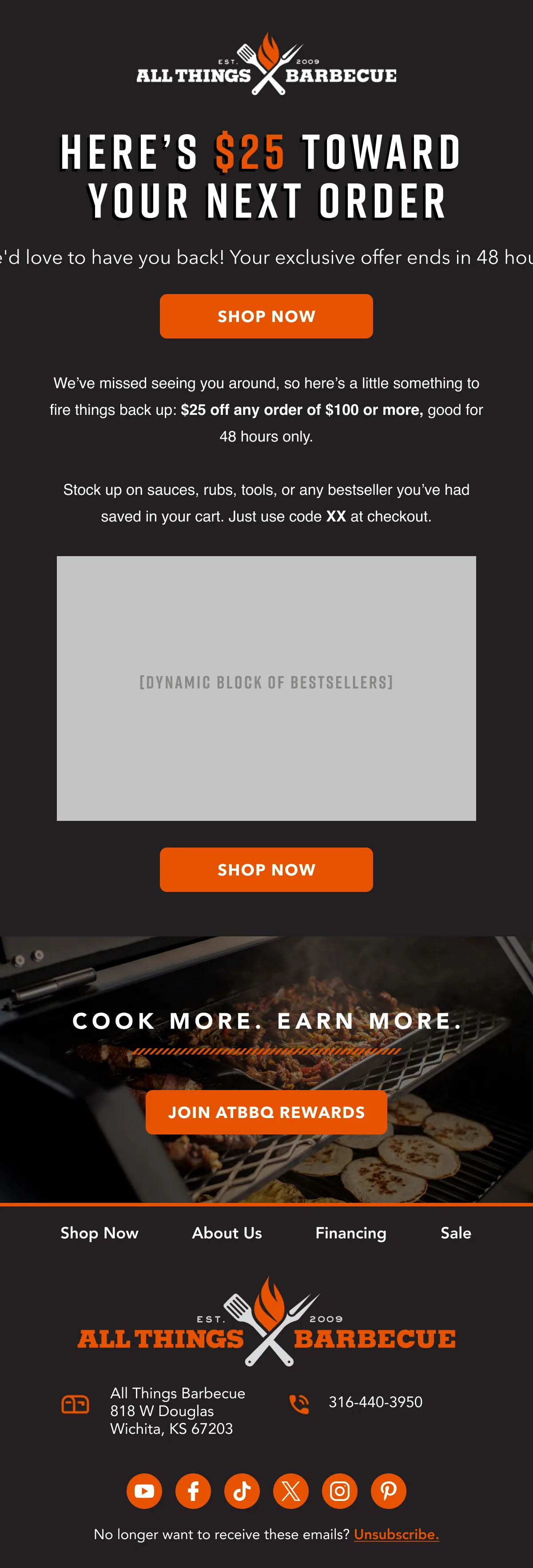
Email 3: $25 off + 48hr urgency
Dri Duck: Three Re-engagement Angles, Zero Discounts
This one breaks the framework on purpose. No offer in any email — instead, three different reasons to come back. Email 1 leads with new arrivals. Email 2 pivots to a category hook ("Ready For Any Weather") for seasonal layering. Email 3 closes with reviews and best-sellers. This shape works for brands with durable, high-AOV products where customers repurchase on need, not promotion — and where a permanent discount culture would erode brand equity.
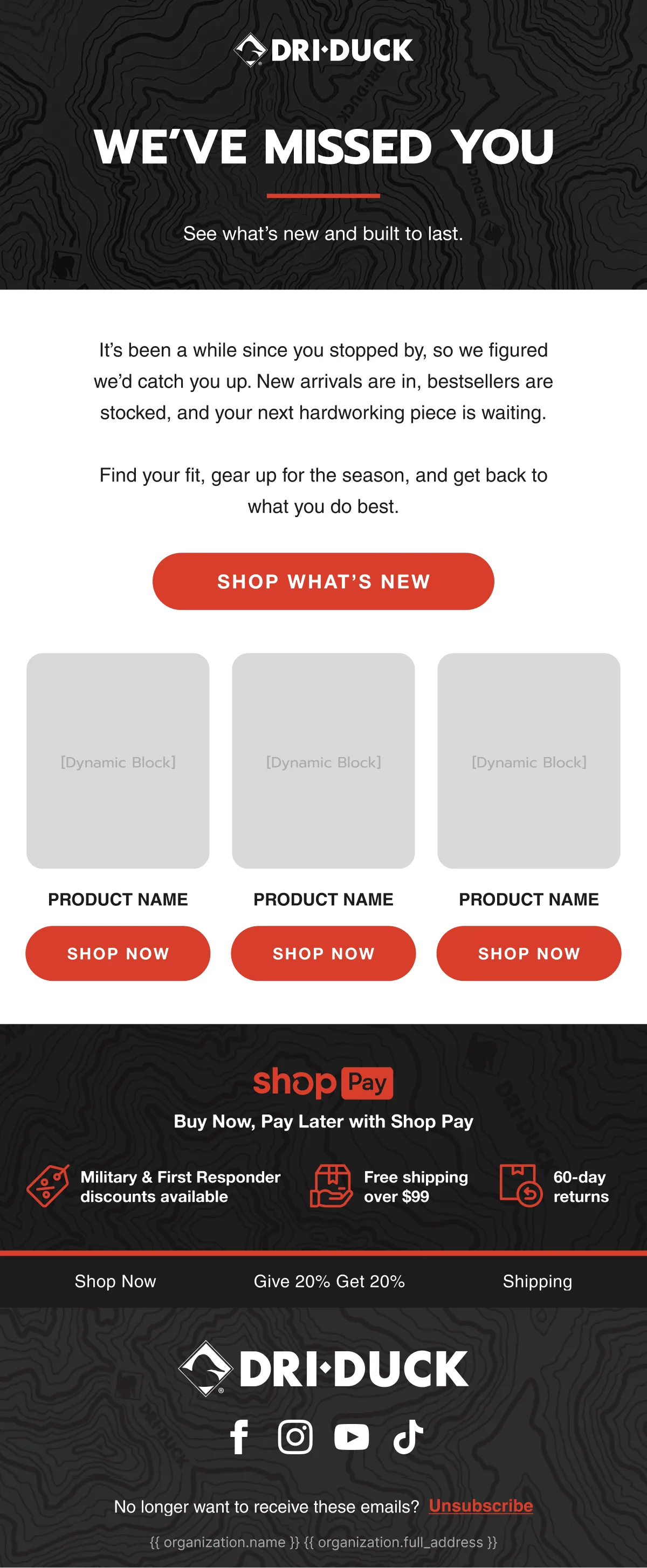
Email 1: New arrivals
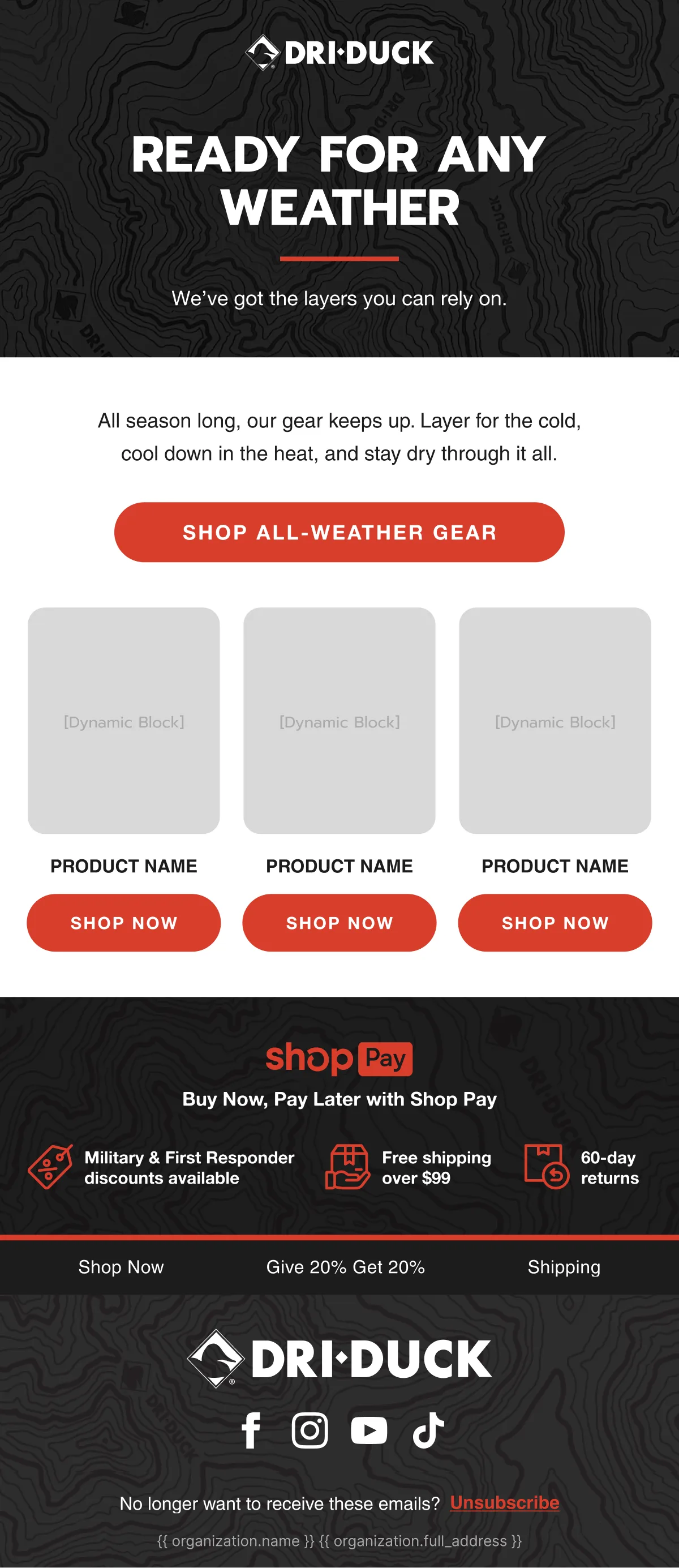
Email 2: Seasonal category

Email 3: Reviews + bestsellers
Three brands, three winback rhythms. If you're struggling to pick which one fits, default to the Essentials 360 classic — it's the highest-converting baseline for most ecommerce. Move toward the ATBBQ or Dri Duck shapes when your brand can't afford to train customers to wait for a discount.
Stop Using Arbitrary Timing — Use Your Actual Data
This is where most winback guides lose me. They say "set the delay to 180 days" like that number means something universal. It doesn't.
180 days is Klaviyo's default suggestion. It's not based on your customers, your product, or your purchase cycle. It's a guess. And if your customers naturally repurchase every 30 days, waiting 180 days means you're reaching out six purchase cycles late. Those people are gone.
Here's what we do instead: we look at the actual average days between purchases and set the winback trigger at roughly 1.5x that number.
We recently audited a food subscription brand. Their median days between purchases was 28 days and their average was 53 days. The median was dragged down by subscription customers who purchase on a predictable 30-day cycle — that's not useful for winback targeting. The average told a better story: normal one-time buyers were purchasing every 30-50 days.
So where would you start the winback? Not at 180 days. Somewhere in the 50-80 day range. At 1.5x the average, you're catching people right as they've clearly lapsed but before they've completely forgotten about you.
The other variable: what other flows are running. If you have cross-sell, replenishment, or bounce-back flows trying to get them back before the winback, you might push the winback delay out further to avoid overlap. Those flows are already doing re-engagement work. The winback is for people who made it through all of that and still didn't buy.
We use our internal portal because it surfaces the average days between purchases automatically. We're trying to use data as much as we can instead of picking numbers out of the air. If you don't have a tool like that, pull the data from Shopify — export orders, sequence them by customer, and calculate the average gap between first and second purchase. That's your baseline.
To test in Klaviyo, use the 50/50 time delay split. Run it for a few months and compare revenue per recipient between the two branches. The data will tell you what works for your brand.
For a deeper dive on using purchase timing data to set flow delays, check out Predictive Flows from Purchase Paths.
Don't Lead with the Discount
This is a hill we'll die on: Email 1 should not be a discount.
People lapse for different reasons. Some forgot about you. Some got busy. Some found an alternative. Some had a bad experience.
A "here's what you've missed" email re-engages the forgot-and-busy crowd without giving away margin. These people don't need a discount to come back. They just need a nudge.
If you lead with a discount, you train your entire lapsed customer base to expect one. The people who would have come back anyway now get 15% off for free. And the people who left for a real reason? A discount probably isn't solving their problem.
Save the offer for Email 2. Let Email 1 do the relationship work.
Why Winback Should Be Purchase-Triggered, Not Engagement-Triggered
I truly hate engagement segments. They're a self-fulfilling prophecy. You send to the people that engage, and when somebody falls out, you stop sending to them. Obviously they're never going to engage again.
And it gets worse. With Apple Opens muddying the data, engagement segments don't even tell you who's buying. They tell you who's opening. You end up sending to people who engage with the brand but never purchase, and leaving out actual customers who buy but don't click.
Here's where this connects to winback specifically: engagement-based sending creates "phantom segments" — profiles that aren't being sent to and don't show up in your suppression or unengaged audiences. In one audit, we found 1,500 hidden profiles because of filtering mismatches between engagement segments and suppression logic. These people were paying rent in the Klaviyo bill but invisible to every flow and campaign.
That's why we trigger winback on Placed Order, not on engagement activity. Purchase behavior is concrete. Either they bought or they didn't. There's no ambiguity, no Apple Opens problem, no phantom segments.
The same logic applies to campaign exclusions. We audited a brand that was excluding "purchasers in the last 60 days" from campaigns. Sounds reasonable until you look at their data — average repurchase was 30 days. They were actively excluding the people most likely to buy again. Arbitrary time-based rules fail when they're not grounded in actual purchase data. This is true for campaign exclusions and it's true for winback timing.
What Happens After Winback
The winback flow isn't the end of the story.
If the customer re-engages (purchases): They exit the winback flow automatically because of the flow filter (has placed 0 orders since starting this flow). They're back in your normal lifecycle — post-purchase, cross-sell, review request, the whole system.
If the customer doesn't re-engage: They fall through all three emails without buying. Now they're in sunset territory.
The handoff: winback flow ends, 30-60 day buffer, then they enter the sunset/suppression system or get suppressed directly.
What Not to Do: The Daisy-Chained Sunset Disaster
We audited a brand that had built this exact handoff in the worst possible way. They had a re-engagement flow that created a Klaviyo property ("unengaged = true"), which then fed people into a separate sunset flow, which created another property ("to suppress = true") and sent two more emails.
Two flows doing what should be one. The re-engagement flow also had Smart Sending turned on, so people were getting skipped (which is why we never enable Smart Sending in flows). Plus redundant conditional splits checking for conditions the flow filters already handled. Open rate was 3.6%.
The fix was embarrassingly simple: consolidate into one flow, send one email, auto-suppress. Done. Don't over-engineer the winback-to-sunset handoff. One flow. One email. If they don't respond, suppress them.
We wrote a full breakdown of how the sunset and suppression system works, including the webhook-to-API automation that makes it completely hands-off: Automated List Hygiene.
The two flows are companions. Winback tries to save the dormant. Sunset cleans out the dead. Together, they keep your list healthy and your Klaviyo bill honest.
Results and What to Expect
Set expectations now, because winback flows don't look like your other flows in reporting.
Open rates will be lower. You're emailing people who haven't engaged in months. That's normal and it's not the metric that matters.
The metric that matters is revenue per recipient and orders recovered. When lapsed customers convert, AOV tends to be solid because they're returning customers who already trust you — not first-time discount shoppers.
Even 2-3% conversion is meaningful. The audience is large — it's every customer past your repurchase window who hasn't returned. On a brand with 10,000 customers in that group, 2% is 200 recovered orders. At a $75 AOV, that's $15,000 from a flow you built once.
And every customer the winback flow saves is one fewer profile that has to be sunset and suppressed.
Related Reading
- Complete Guide to Klaviyo Flows — The full flow map
- Abandoned Cart Flow Deep-Dive — The flow that catches people before they lapse
- Automated List Hygiene — The sunset and suppression system that picks up where winback leaves off
- Predictive Flows from Purchase Paths — How to use actual repurchase data to set your flow timing
- Segment by Purchase Behavior — How to define "lapsed" based on your real customer data
Want us to build these for you?
We build winback and sunset flows every week. We'll audit what you have and tell you straight up what's working and what's not.