Post-Purchase Emails in Klaviyo: Real Examples + Setup Guide
The post-purchase flow is where most brands leave the most money on the table. They send an order confirmation and move on. Meanwhile, the customer is at peak excitement about the brand — and nobody's talking to them.
We build post-purchase flows for every client. The structure is always the same: thank them, reinforce the brand, then set up the next purchase. But how you do that depends on whether they're a first-time buyer or a repeat customer.
Below is the full setup guide for Klaviyo, plus real post-purchase email examples from brands we work with.
Why Post-Purchase Emails Matter More Than You Think
The window between "order placed" and "order delivered" is the highest-engagement period in the entire customer lifecycle. Open rates on post-purchase emails routinely hit 60-70% — double what campaigns get.
Most brands waste this window on transactional noise. The order confirmation goes out (often Shopify's default), then silence until the next sale campaign. By the time they email again, the customer has forgotten why they bought in the first place.
A proper post-purchase flow uses this high-engagement window to build brand affinity, reduce buyer's remorse, and plant the seed for the second purchase — which, based on our repeat purchase rate benchmarks, is the single most important conversion in the customer lifecycle.
The First-Time Buyer Post-Purchase Flow (3 Emails)
First-time buyers need different treatment than repeat customers. They don't know your brand yet. They may have buyer's remorse. They need reassurance that they made the right choice and reasons to come back.
The Technical Setup
- Trigger: Placed order
- Conditional split: Has placed order exactly 1 time over all time (YES = first-time buyer, NO = repeat)
- Initial delay: Immediately after order (or 1 hour if you want to avoid stacking with order confirmation)
- Flow filters: Has not refunded/cancelled since entering flow
The Emails
Email 1: Personal Thank You + Brand Story
Triggers immediately or 1 hour after purchase
This is not a receipt. That's Shopify's job. This email welcomes them to the brand. Thank them for their purchase, tell them what makes you different, and give them a reason to feel good about the choice they just made.
The best versions of this email feel personal — like a founder note, not a marketing blast. Include a photo of the team, the workshop, or the product being made. If your brand has a story worth telling, this is where to tell it.
Email 2: Product Education — How to Use, Care For, or Get the Most From What They Bought
Delay: 2-3 days after Email 1 (or timed to arrive around delivery)
This email reduces returns and increases satisfaction. If you sell apparel, it's care instructions and styling suggestions. If you sell food, it's recipes or serving ideas. If you sell supplements, it's usage tips and what to expect.
The goal is to make the product more valuable by teaching the customer how to get more out of it. This is also a natural place to cross-sell — "you bought the shirt, here's the jacket that completes the look."
Email 3: Review Request or Survey
Delay: 5-7 days after Email 2 (give them time to actually use the product)
Once they've received and used the product, ask for a review or feedback. If you use Okendo, Yotpo, or Judge.me, this email can link directly to the review form. If you want richer data, run a post-purchase survey — "how did you hear about us?" and "what almost stopped you from buying?" are two of the most valuable questions you can ask.
Some brands incentivize the review with a small discount on the next order. This serves double duty — you get UGC and you plant the seed for purchase #2.
The Repeat Buyer Post-Purchase Flow (2 Emails)
Repeat buyers don't need the brand story. They already know you. The post-purchase flow for returning customers is shorter and more focused.
Email 1: Thank You + Loyalty Recognition
Acknowledge that they're coming back. "Welcome back" hits differently than "thank you for your order." If you have a loyalty program, reinforce their status and points balance. If not, a simple "you're one of our best customers" goes a long way.
Email 2: Cross-Sell Based on Purchase History
This is where purchase path data becomes powerful. Instead of generic best sellers, recommend the product they're most likely to buy next based on what other customers with similar purchase histories bought. Klaviyo's product recommendation blocks can do this dynamically.
Details That Matter
Timing Around Delivery
The biggest timing mistake is sending "how's your product?" before the product arrives. If you integrate Shopify's fulfillment events with Klaviyo, you can trigger emails based on "order fulfilled" instead of "order placed," which naturally accounts for shipping time.
If you don't have fulfillment triggers set up, add enough delay to account for your average shipping time. Better to email a day late than ask for a review before the box arrives.
Don't Compete With Shopify's Transactional Emails
Shopify already sends order confirmation, shipping confirmation, and delivery confirmation. Your Klaviyo post-purchase flow is not a replacement for those — it's a supplement. The Shopify emails handle logistics. Your flow handles relationship building.
If you want to consolidate everything in Klaviyo (some brands do), you can disable Shopify's transactional emails and rebuild them as Klaviyo flows. But that's a bigger project and needs careful testing.
Suppression: Don't Email During Returns
If a customer initiates a return or refund, they should exit the post-purchase flow immediately. Nothing kills brand trust faster than "we hope you love your purchase!" landing in someone's inbox while they're boxing up a return. If you use Loop or Returnly, these events can be synced to Klaviyo as flow filters.
Real Post-Purchase Email Examples
Here are post-purchase emails we've built across different ecommerce verticals. Each follows the framework above — but the tone, content, and cross-sell approach differ based on the brand and product.
Email 1: The Thank You
The first email welcomes the customer and reinforces the brand. No selling, no cross-sell — just gratitude and brand story.
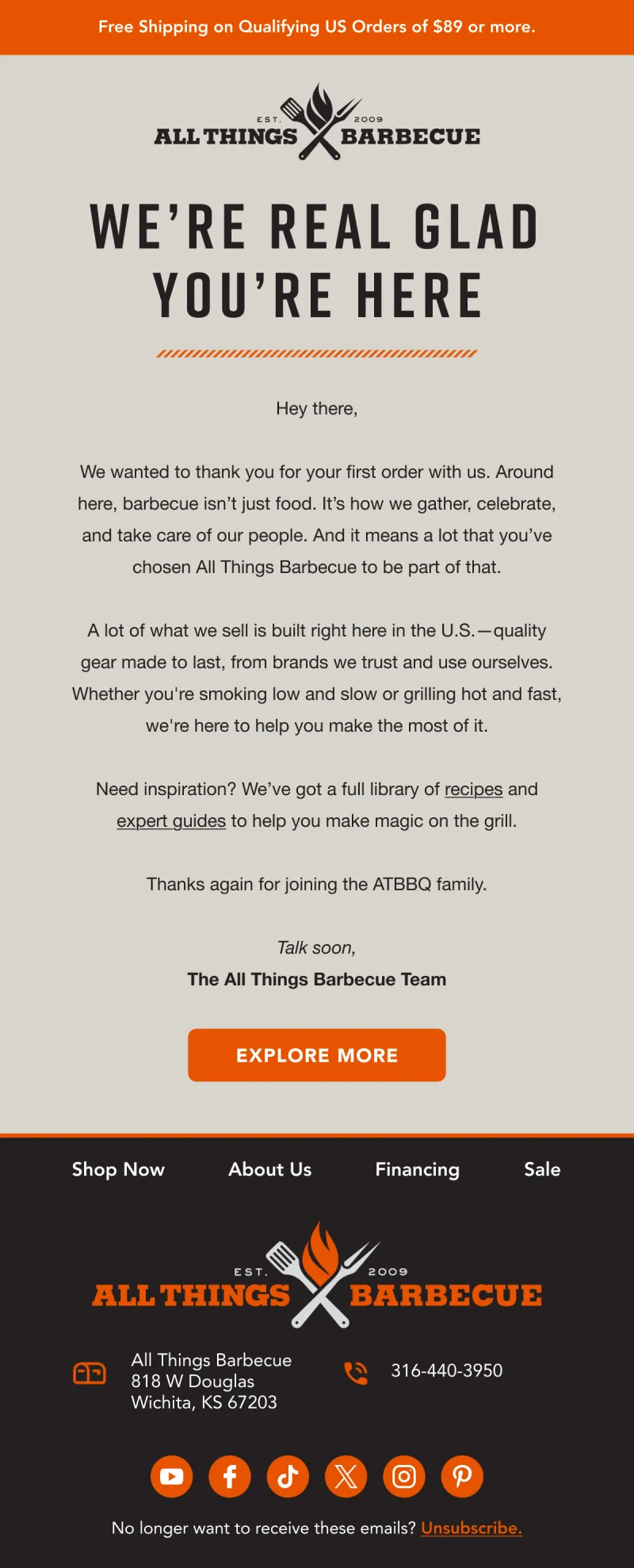
BBQ & grilling. "We're Real Glad You're Here" — warm, personal tone. Links to recipes and expert guides immediately, giving the customer a reason to engage beyond the purchase. Feels like a founder letter, not a template.
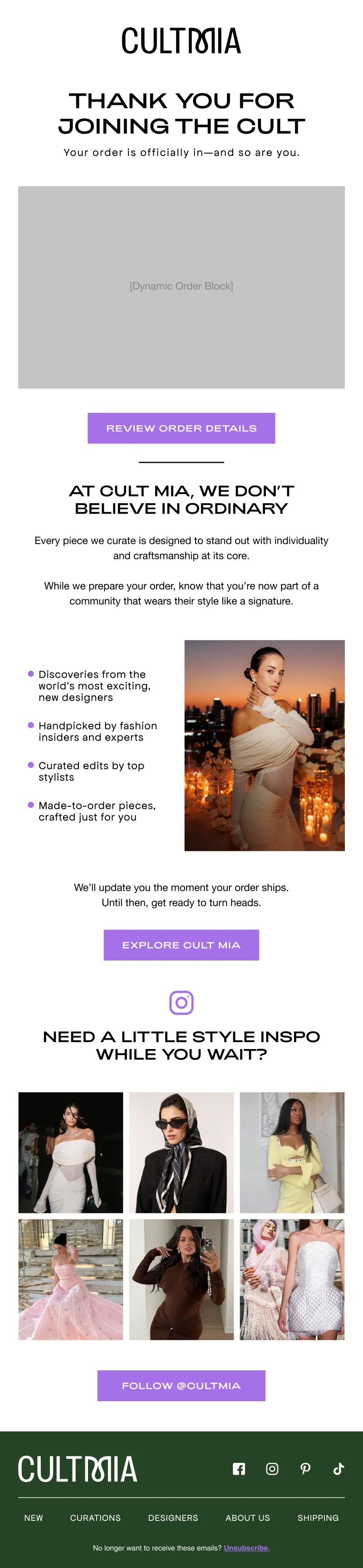
Fashion marketplace. "Thank You for Joining the Cult" — makes the customer feel like they've joined a community, not just made a purchase. Lists brand differentiators (independent designers, handpicked curation).
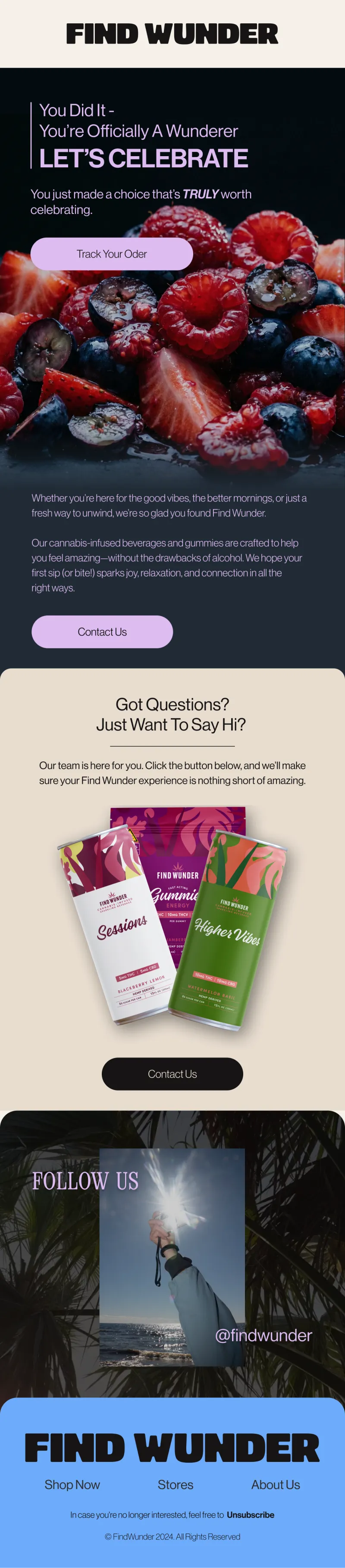
Wellness brand. "You're Officially a Wunderer" — creates an identity around the purchase. Vibrant imagery, includes a customer service touchpoint and social follow CTAs. Sets the tone for the entire post-purchase relationship.
Email 2: Product Education + Cross-Sell
The second email teaches the customer how to get the most from their purchase, and naturally introduces complementary products.

BBQ & grilling. Product education that's genuinely useful — grilling tips, recipe links, and how to get the most from what they bought. The cross-sell is woven into the content naturally: "here's what pairs well with your purchase."

Wellness brand. Combines product education (how to use, what to expect) with brand values reinforcement. Shows complementary products from the range. This is the email that reduces returns and increases satisfaction.
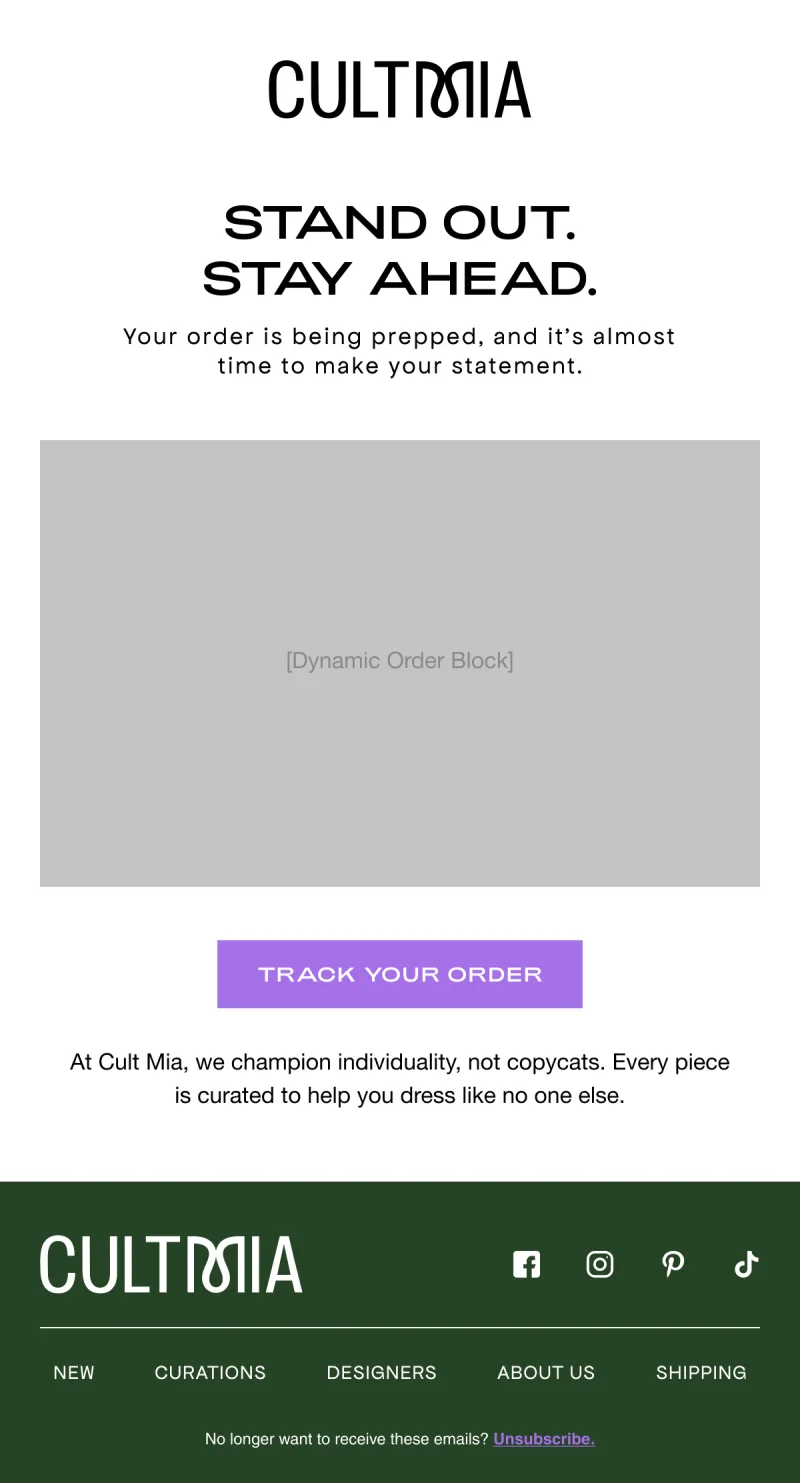
Fashion marketplace. Style inspiration while the customer waits for delivery. Keeps engagement high during the shipping window and naturally drives browsing behavior.
Email 3: Review Request / Survey
The final email asks for feedback once the customer has had time to use the product.
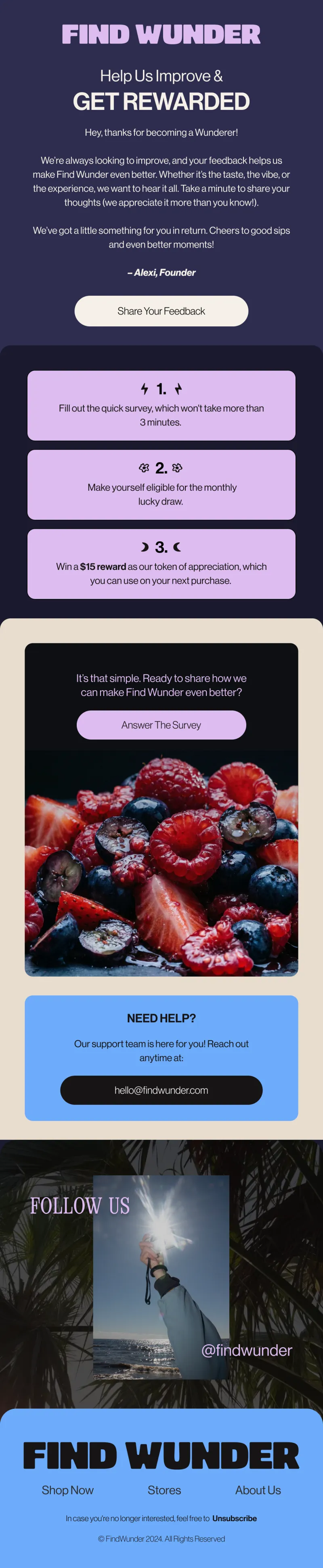
Wellness brand. Post-purchase survey with an incentive. Asks for product feedback and how they discovered the brand — valuable zero-party data that improves future marketing and product development.
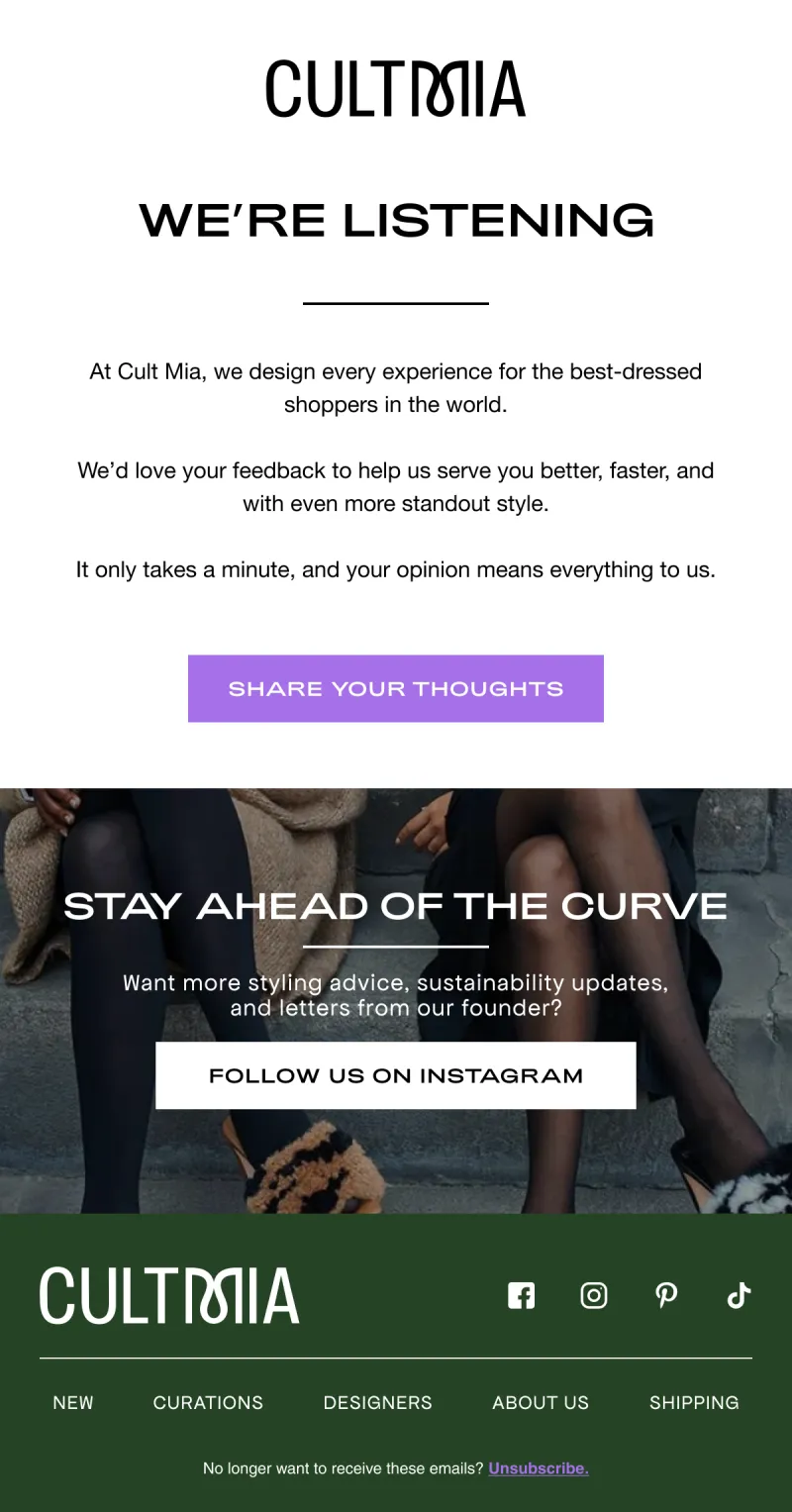
Fashion marketplace. Review request combined with more styling suggestions. Keeps the email useful even if they don't leave a review — always give a secondary reason to open.
The Repeat Buyer Difference
Repeat buyers get a shorter, more direct flow. They don't need the brand story — they already know you. The tone shifts to appreciation and recognition.
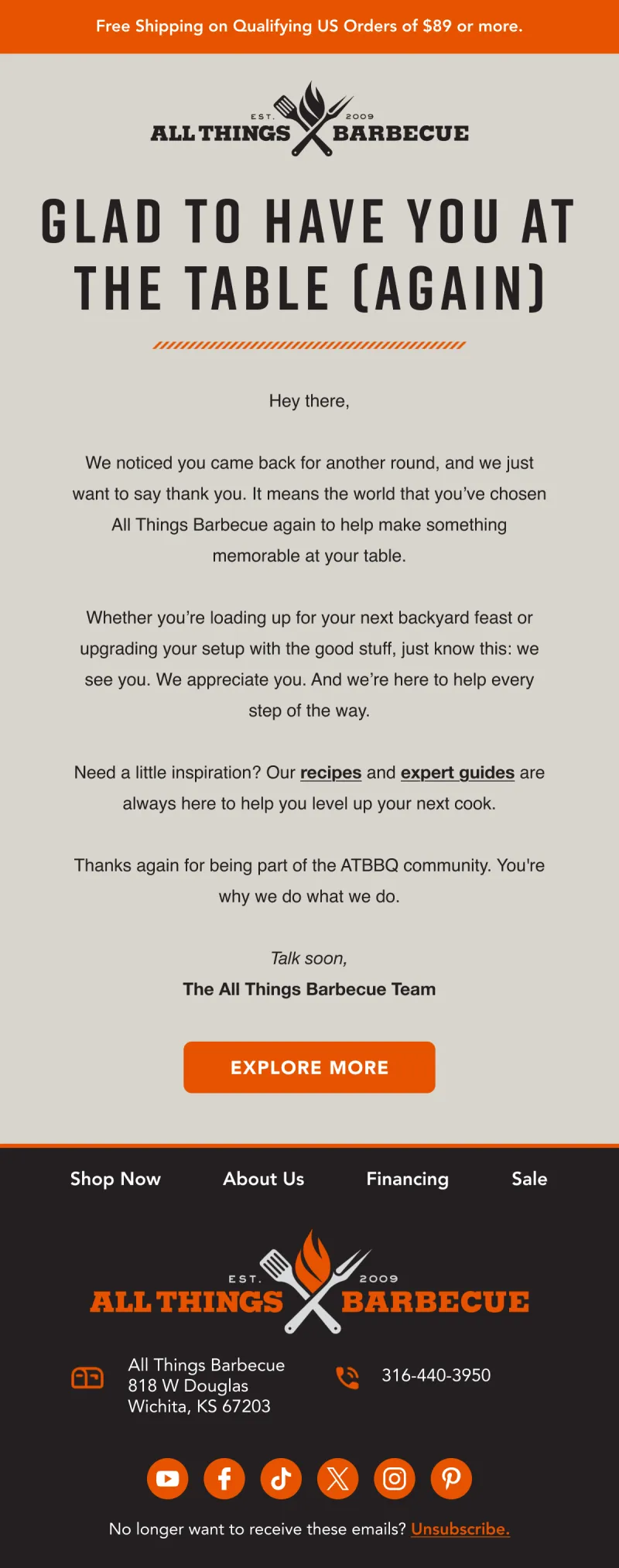
BBQ & grilling (repeat buyer). "Glad to Have You at the Table (Again)" — acknowledges they're coming back without re-telling the brand story. Compare this to the first-time version above: same brand, same template, completely different messaging.
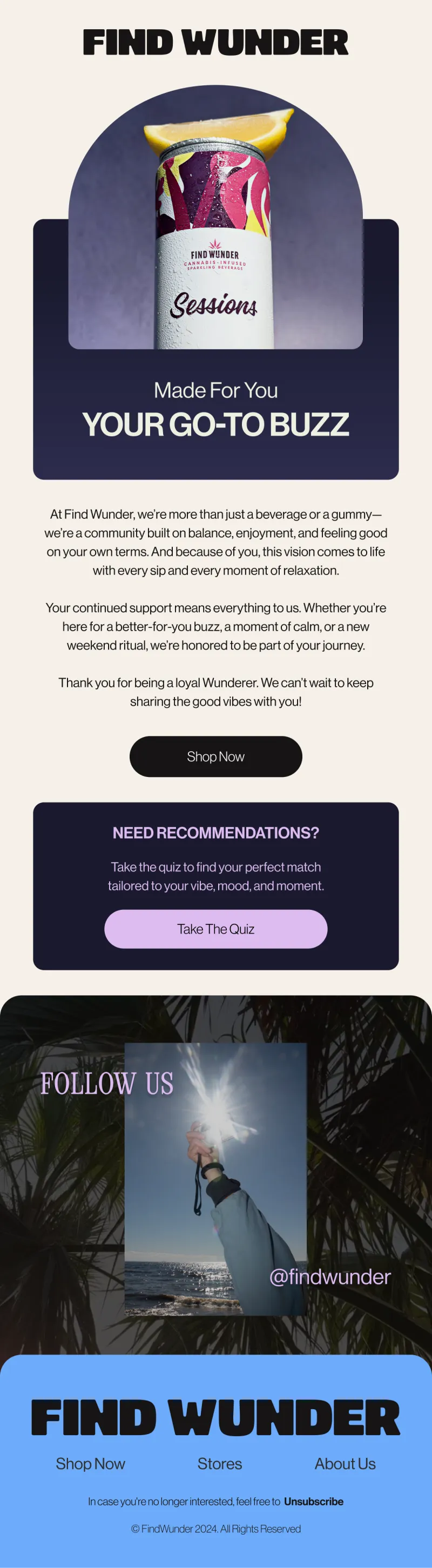
Wellness brand (repeat buyer). Acknowledges them as a returning customer. Reinforces brand values without re-telling the whole story. The cross-sell here is based on what they haven't tried yet, not generic best sellers.
How This Connects to Your Other Flows
Post-purchase sits at a critical junction in the customer lifecycle. Abandoned cart flows bring people to the purchase. Post-purchase flows set up the second one. And when they don't come back, winback flows pick up where post-purchase left off. For the full architecture, see our Complete Guide to Klaviyo Flows.
Build These for Your Store
- Flow Builder Tool — scope out which flows you need and what they cost
- Abandoned Cart Flow Guide — the flow that brings people to the purchase
- Purchase Path Data — how to use actual customer behavior for cross-sell recommendations
- Repeat Purchase Rate Benchmarks — what good looks like for second purchases
- Complete Guide to Klaviyo Flows — the full architecture
Want us to build your post-purchase flow?
We'll audit your current setup, build first-time and repeat buyer paths, and set up the cross-sell logic.