10 Best Welcome Flow Email Examples That Actually Convert
10 Best Welcome Flow Email Examples That Actually Convert
Last updated: February 2026
Most welcome flow advice tells you to "introduce your brand" and "make a great first impression." That's not wrong, but it misses the point. The welcome flow has one job: get the person to buy. Every email in the sequence should push toward that conversion, and anything that doesn't serve that goal is wasting your highest-intent window.
We build and manage welcome flows across dozens of ecommerce brands in Klaviyo. Below are 10 real examples that show what works, broken down by what each email does well and why it converts.
Table of Contents
- The 5-Email Welcome Flow Framework
- 10 Welcome Flow Email Examples
- Using First-Party Data to Personalize Your Welcome Flow
- SMS in Welcome Flows: Two Approaches
- 5 Common Welcome Flow Mistakes
- How Long Should Your Welcome Flow Be?
- FAQ
The 5-Email Welcome Flow Framework
Our standard welcome flow is five emails, each sent 24 hours apart. The first email fires immediately after signup. We don't space these out over weeks because the goal is to hit people frequently while their intent is at its peak — they just gave you their email because they're interested. That interest decays fast. Our time to first purchase benchmarks show the real window is about 7 days — and 66% of subscribers have already bought before the welcome flow even sends.
One Klaviyo technicality that breaks this if you miss it: Email 1 only fires immediately if Smart Sending is turned off on the email. With Smart Sending on, any subscriber who received a campaign in the last 16 hours silently misses Email 1 — and Email 1 is the highest-converting email in the entire sequence. See Klaviyo Smart Sending: Turn It Off in Flows for the full case.
The conversion curve backs this up: Email 1 drives the highest conversion rate by far. Emails 2 through 4 drop off, and then Email 5 — the last-chance closer — typically gets a bump as urgency kicks in.
Here's the framework:
Email 1 (Immediate): Welcome + offer. Lead with the discount, BOGO, free shipping, or whatever the signup incentive is. Introduce the brand briefly, but the offer is the star. This email converts the most — don't bury the CTA. Still deciding how deep the signup offer should go? Our discount margin calculator shows the sales volume each discount level has to generate to pay for itself.
Email 2 (Day 2): Best sellers + offer. Show your most popular products. Let the catalog do the convincing. Reiterate the offer prominently.
Email 3 (Day 3): Brand differentiators + offer. What makes you different from every other brand in your category? This is where you earn trust. But you're still selling — the offer is still front and center.
Email 4 (Day 4): Social proof + offer. Customer reviews, testimonials, UGC, press mentions. Let other people do the selling for you. Reiterate the offer.
Email 5 (Day 5): Last chance. The offer is expiring. This is your final push. Create urgency and make it clear — this is their last opportunity to get the discount.
The common thread: every single email includes the offer. Not just Email 1 and Email 5. Every one. The person signed up because of that offer. Reminding them of it in every touchpoint is not aggressive — it's the entire reason they're in your flow.
You can build and visualize this entire sequence in our free Klaviyo Flow Builder.
10 Welcome Flow Email Examples
These are real welcome flow emails from ecommerce brands. For each one, we break down what it does right, what role it plays in the sequence, and what you can learn from it.
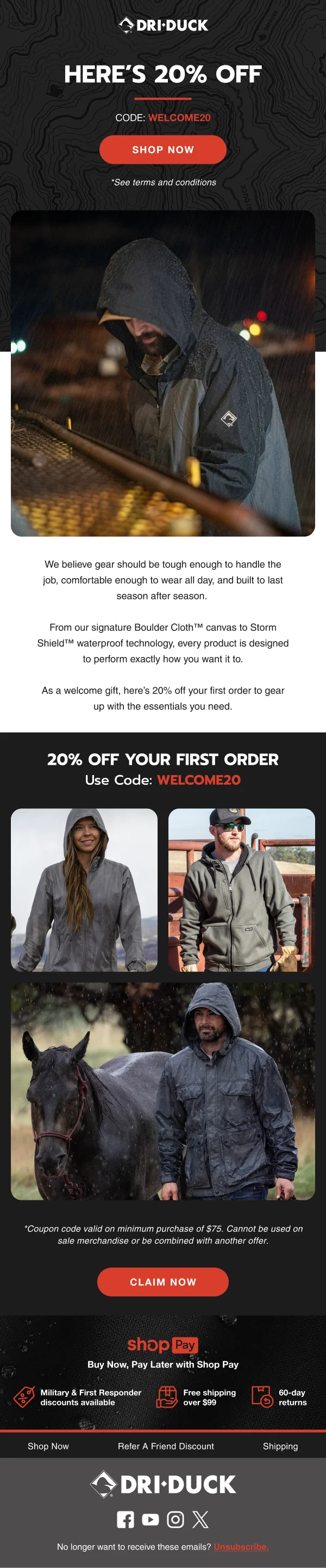
1. Email 1 — Welcome + Offer: Leading With the Incentive
What it does right:
- Discount code is impossible to miss — "HERE'S YOUR 20% OFF" is the headline, code WELCOME20 is right there
- Brief brand introduction that positions the product ("tough enough to handle the job, comfortable enough to wear all day") without going overboard
- Single, clear "SHOP NOW" CTA that takes you straight to the store
- Offer is repeated at the bottom with a secondary CTA — catches people who scroll past the hero
Takeaway: Email 1 is not the place to tell your life story. The person just signed up for a discount. Give them the discount and make it easy to use.
2. Email 1 — Welcome + Offer: A Different Offer Format

What it does right:
- Uses a flat dollar amount with a minimum purchase threshold ($10 off orders $75+) instead of a percentage — this can feel more tangible and encourages a higher AOV
- Immediately shows best sellers ("Not Sure Where to Start? These Sell Out Fast") so the customer knows what to spend the offer on
- Brief brand credibility ("Over 100 Years in the Making") and a satisfaction guarantee — removes purchase anxiety without being long-winded
Takeaway: The offer doesn't have to be "X% off." Flat dollar amounts, minimum purchase thresholds, free shipping, and bundle deals can all work as welcome incentives — the key is making the value unmistakable and easy to act on.
3. Email 2 — Best Sellers + Offer

What it does right:
- Each product gets its own description and "SHOP NOW" button — multiple entry points to the store instead of one generic CTA
- Discount code reminder is woven in naturally ("Use XXX to claim your 10%") — not buried, not screaming
- Copy leans into what makes each product unique ("Stalwart, smokey, pantry-ride-or-die") rather than generic product names
Takeaway: By day 2 the person has already heard the brand pitch. Now let the catalog do the talking. Show them what other people are buying and remind them their offer is still active.
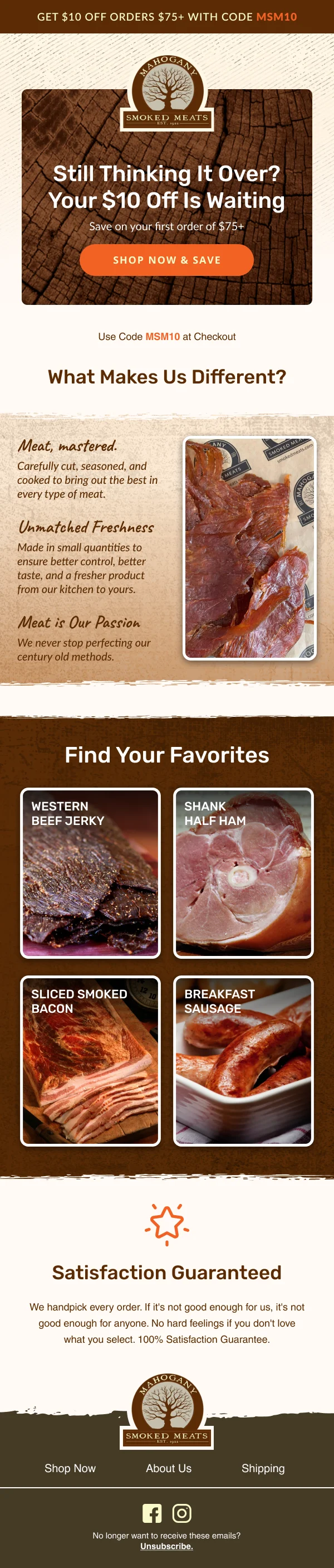
4. Email 3 — Brand Differentiators + Offer
What it does right:
- Leads with "What Makes Us Different?" and answers with specifics — hand-seasoned meats, no preservatives, generational passion — not vague brand platitudes
- Still selling — "Find Your Favorites" product section sits right below the story, and the $10 offer is persistent throughout
- Satisfaction guarantee at the bottom removes the last objection ("It's not good enough for us, it's not good enough for you")
Takeaway: Brand story emails work when they answer "why should I buy from you instead of someone else?" If it reads like an About Us page, it's not doing its job. Keep it short, make it about the customer, and keep the offer visible.
5. Email 4 — Social Proof + Offer

What it does right:
- Lets customers do the selling — named reviewers with star ratings and their own words, not generic "our customers love us" copy
- Multiple reviews build a pattern — one review is a data point, four reviews from different people is a trend
- Offer reminder sits at the bottom ("Your $10 off is still waiting") — after the reviews have done the convincing, the CTA is right there
Takeaway: By Email 4, you've told the person about your brand, shown them products, and given them an offer. If they still haven't bought, what they need is trust. Other customers' words do that better than yours.
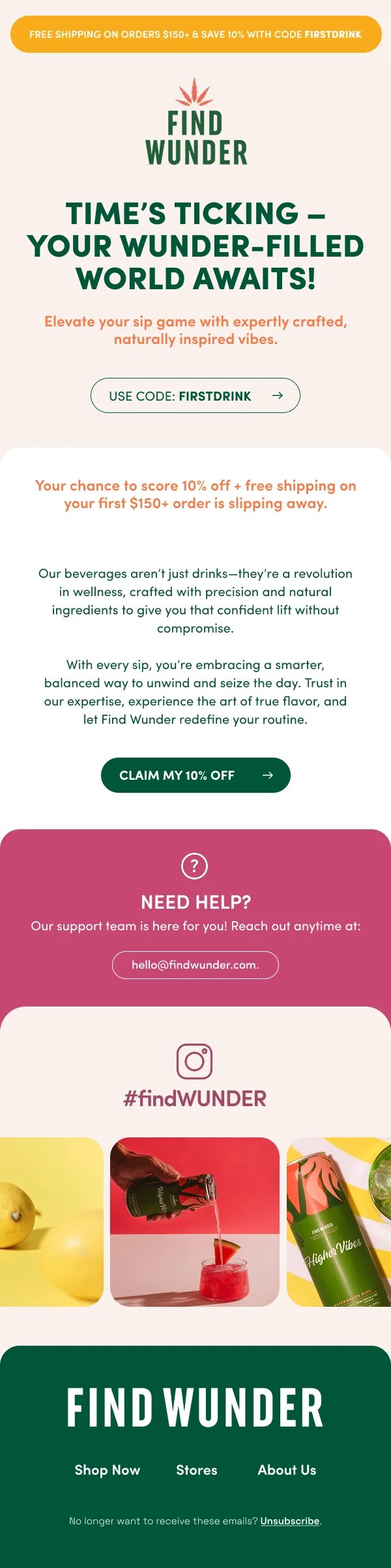
6. Email 5 — Last Chance / Offer Expiring
What it does right:
- Clear urgency — "Time's ticking" headline with "your chance to score 10% off is slipping away"
- Stripped down to essentials — offer code, a brief value reminder, and the CTA. No product grids, no reviews, no brand story
- Short, punchy copy that gets to the point and doesn't waste the reader's time
Takeaway: This email typically gets a conversion bump because loss aversion is real. People who were on the fence all week will act when they realize the offer is about to disappear. Keep it simple and urgent.
7. First-Party Data Popup — Problem-Solution Brand
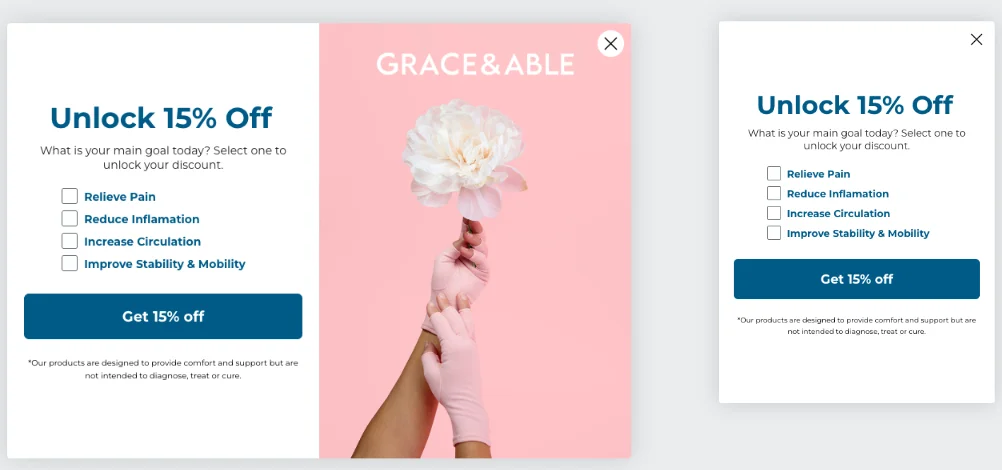
This isn't an email — it's what happens before the flow starts, and it's one of the most impactful things you can do. By asking one small question on the signup popup, you collect first-party data that lets you customize the entire welcome sequence.
How it works in practice:
- Supplements / health brands: "What best describes what you're trying to solve?" — options like gut health, energy, sleep, etc.
- Wellness / problem-solution products: "What are you trying to alleviate?" — options mapped to the specific conditions the product addresses
- Workwear / apparel: "What best describes your needs?" — options like durable gear for job sites, stylish everyday wear, or maximum warmth
Takeaway: One question on the popup. That's it. The person still gets the same offer. But now your welcome flow can speak directly to their specific pain point instead of guessing. Use our Audience Builder to create segments based on these popup responses.
8. Personalized Welcome Email — Branched Based on Popup Response
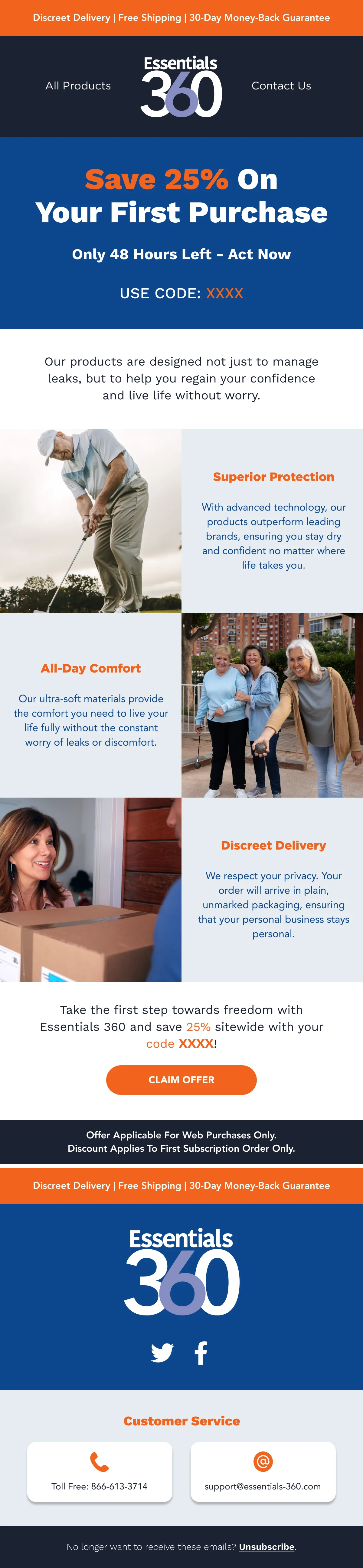
This is what the first-party data enables. The flow uses the same 5-email framework, but it branches at the beginning based on the popup answer. This email is from a wellness brand where customers have very different reasons for buying — and the messaging speaks directly to specific concerns rather than trying to be everything to everyone.
What it does right:
- Benefit sections speak to specific concerns — "Superior Protection," "All-Day Comfort," "Discreet Delivery" — each addressing a different reason someone would buy
- Positions the product as the solution to their problem, not a generic pitch ("designed not just to manage leaks, but to help you regain your confidence")
- Same offer (25% off), same structure — but in a branched flow, the headline and benefit emphasis would shift based on what the customer told you they care about most
Takeaway: You're not building three entirely different flows. It's the same skeleton — offer, best sellers, differentiators, social proof, last chance — with the messaging and product selection tailored to each branch. The structure scales; the personalization converts.
9. Welcome Email With Strong Visual Hierarchy
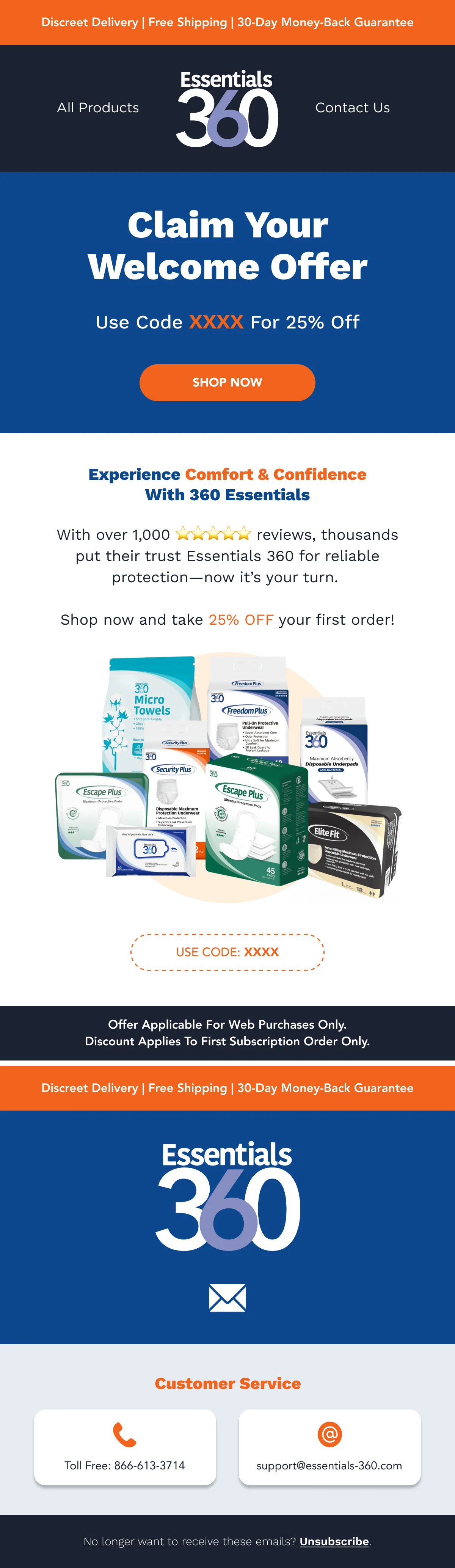
What it does right:
- Visual hierarchy guides the eye perfectly: bold "Claim Your Welcome Offer" headline, code front and center, "SHOP NOW" CTA, then product imagery — in exactly that order
- Minimal copy — the design does the heavy lifting. You know what the offer is and how to use it within two seconds
- CTA button is large, high-contrast (orange on white), and impossible to miss on mobile
- Trust signals at the top (Discreet Delivery, Free Shipping, Money-Back Guarantee) address objections before the customer even scrolls
Takeaway: A welcome email doesn't need to say a lot. Sometimes the most effective emails are the ones that get out of the customer's way and make it dead simple to click through and shop.
10. Full Sequence Overview — 5 Emails Working Together
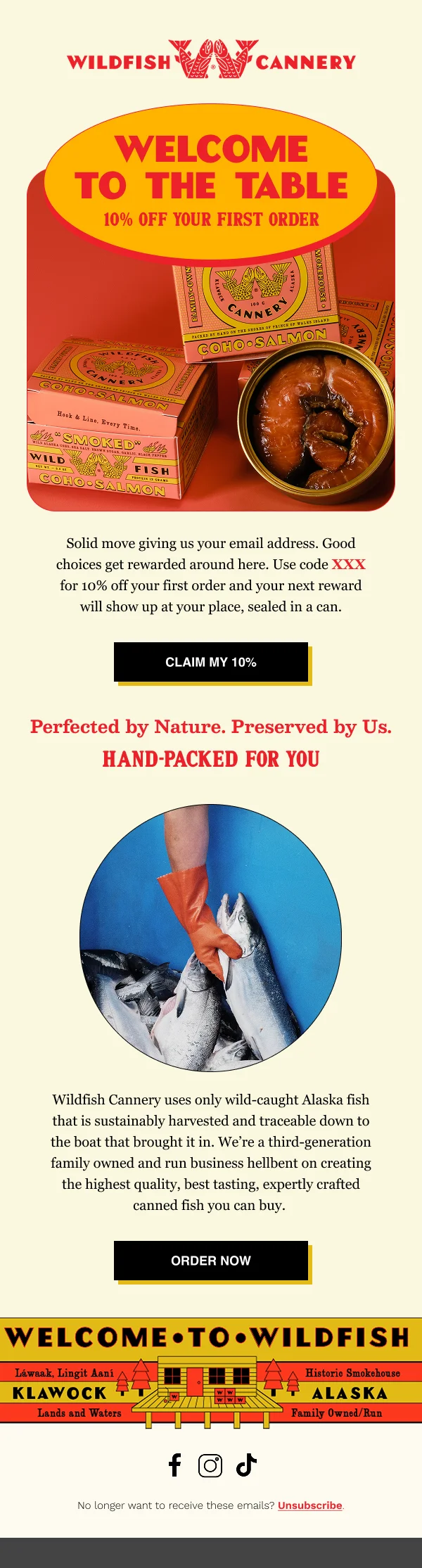
Email 1: Welcome + Offer

Email 2: Best Sellers

Email 3: Social Proof
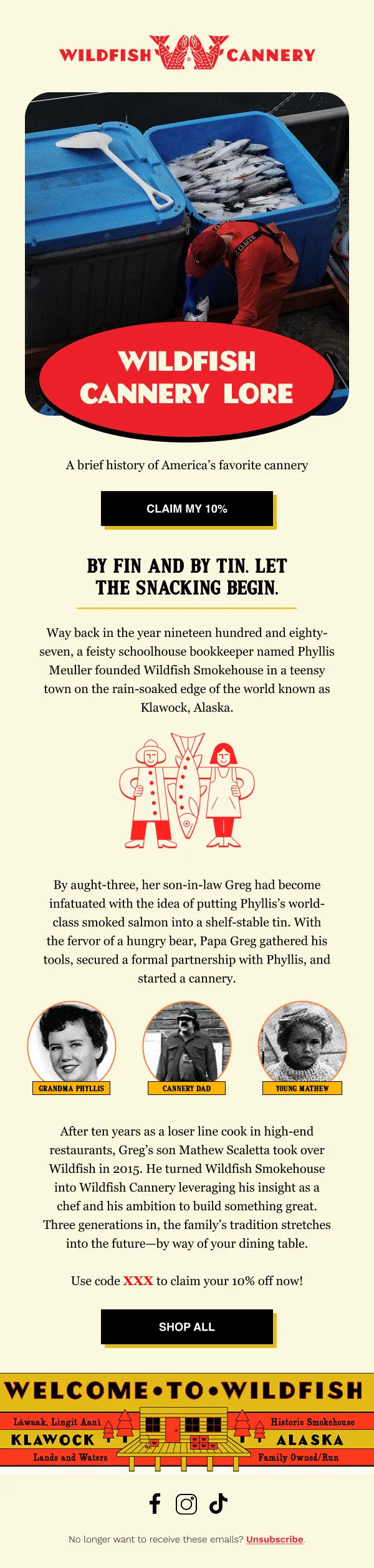
Email 4: Brand Story
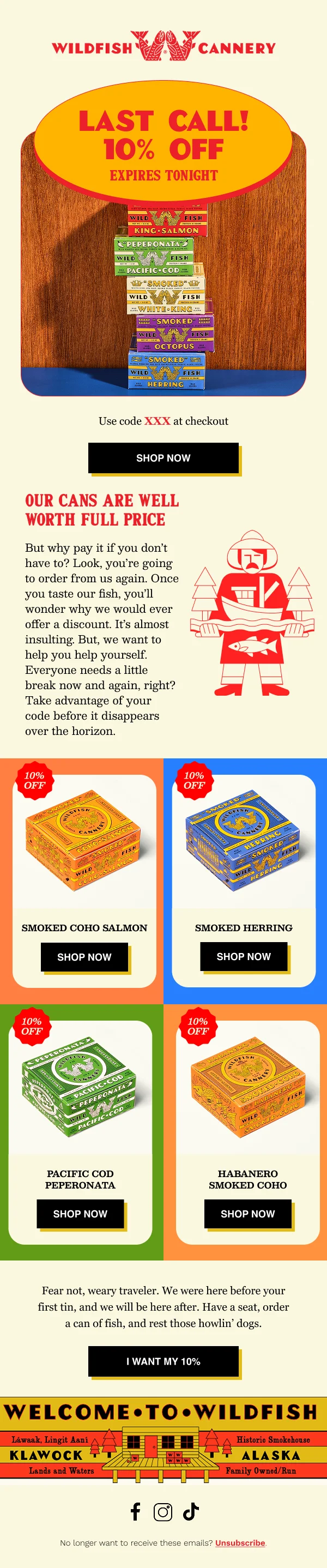
Email 5: Last Chance
This is the full picture — all five emails from Wildfish Cannery's welcome flow, showing how the sequence builds from welcome to close. The 10% offer is present in every single email, but the supporting content evolves: introduction, best sellers, customer reviews, brand history, and finally urgency.
What the full sequence shows:
- Each email has a distinct job — "Welcome to the Table," "Crafted in Alaska," "Oh My Stars" (reviews), "Wildfish Cannery Lore" (story), and "Last Call!" No two emails repeat the same angle
- The 10% offer acts as a consistent thread — "Claim My 10%" appears in every email, tying the whole sequence together
- Design language is cohesive (warm colors, hand-crafted feel, consistent footer) but each email stands on its own
- The progression builds a case for buying — by Email 5, the customer has seen the products, read the reviews, learned the story, and now faces a deadline
Using First-Party Data to Personalize Your Welcome Flow
The biggest lever most brands aren't pulling in their welcome flow is first-party data collection. By adding one qualifying question to your signup popup, you can branch your entire welcome sequence based on the customer's answer.
The mechanics are straightforward: your popup collects the answer as a custom property in Klaviyo. Your welcome flow starts with a conditional split on that property. Each branch uses the same 5-email framework — same timing, same offer, same structure — but the copy, product recommendations, and positioning are tailored to the specific answer.
Real examples of questions we use:
Supplement brand (gut health): "What best describes what you're looking to improve?" → Digestion / Energy / Immunity / General Wellness
Health product brand (compression gloves): "What are you trying to alleviate?" → Arthritis / Carpal tunnel / General stiffness / Recovery from injury
Men's workwear brand: "What best describes your needs?" → Durable, reliable gear for job sites / Long-lasting, stylish everyday wear / Dressing for maximum warmth
The key is asking a question where you can meaningfully change the messaging based on the answer. If every answer would lead to the same email, don't bother asking. But when you sell products that solve different problems for different people, this turns a generic welcome flow into one that feels like it was written specifically for the reader.
SMS in Welcome Flows: Two Approaches
If you're collecting SMS consent alongside email, you have two options for how to handle it in the welcome flow. The right approach depends on your offer structure.
Approach 1: Separate Flows (Standard)
Your email welcome flow and SMS welcome flow are independent. The email flow triggers when someone joins your email list. The SMS flow triggers when someone opts into SMS. If they do both, they get both flows running in parallel.
This is the simpler setup and works well when your email and SMS offers are the same.
Approach 2: Integrated Flow With Escalating Offer
This is for when you're using an escalating offer — for example, 10% off for email signup, then an additional 5% (15% total) if they also opt into SMS. In this case, you need to build it as a single flow because the two audiences are getting different offers.
The setup: the flow triggers on signup, includes a short delay to let the SMS opt-in complete, then splits based on whether the person accepted SMS. The SMS branch gets the higher offer across both channels. The email-only branch gets the standard offer.
This takes more work to build but it's worth it when the escalating offer is a core part of your acquisition strategy.
5 Common Welcome Flow Mistakes
We audit a lot of Klaviyo accounts. These are the welcome flow problems we see the most:
1. Not reiterating the offer in every email
The most common mistake, by far. Brands put the discount in Email 1 and then forget about it in Emails 2 through 5. The offer should be present — prominently — in every single welcome email. It's the reason the person signed up.
2. Too much brand fluff, not enough selling
Your welcome flow is not an About Us page. A light brand story has a place (Email 3), but it needs to be framed in terms of why the customer should care. If you're spending three paragraphs on your founding story and zero paragraphs on why the person should buy, the email isn't doing its job.
3. Asking people to follow you on social media
This one is surprisingly common and it makes no sense. You have a person in your welcome flow who hasn't bought yet. The goal is to get them to purchase. Asking them to go follow you on Instagram sends them off your site and away from the purchase you're trying to drive. The chances that a non-customer follows your brand on social are extremely low, and you're sacrificing valuable email real estate to ask. Save social asks for post-purchase flows.
4. Making the flow too short
One or two welcome emails is not enough. You need enough touchpoints to make the case for buying — and to create the urgency of an expiring offer. Five emails is our standard. You can go longer depending on your campaign cadence (more on that below).
5. Spacing emails too far apart
We see flows where the second email doesn't send until day 4 or 5. By then, the person has moved on. The welcome window is when intent is highest — they just gave you their email. Send daily (every 24 hours) for the first five days. It's not too much. It's the right amount for someone who just raised their hand.
For a deeper look at how we audit flows and find these issues, read our quarterly email audit framework.
How Long Should Your Welcome Flow Be?
Five emails is our standard, but the real answer depends on your campaign frequency.
If you're sending campaigns regularly (2-4 times per week), five emails is plenty. Once the welcome flow ends, your campaigns will pick those people up and keep them engaged. If you're smart about it, you're including the welcome discount in campaigns targeting people who signed up but haven't purchased — so the selling continues even after the flow ends.
If you're a brand that sends campaigns less frequently (once a week or less), you should consider extending the welcome flow — 7 to 10 emails — to fill the gap. Without regular campaigns picking up where the flow left off, a short welcome flow means the person might not hear from you for days or weeks after it ends. That's a lot of dead air during a window when they could still convert.
The principle: somebody should always be hearing from you, whether it's the flow or a campaign. If there's a gap, extend the flow to cover it.
Need help building a welcome flow that converts?
We build and manage Klaviyo email flows for ecommerce brands. If your welcome flow isn't performing, we can audit it and tell you exactly what to fix.
Frequently Asked Questions
How many emails should be in a welcome flow?
Five is a strong starting point. If you send campaigns frequently (2-4x/week), five is likely enough. If your campaign cadence is lower, extend the flow to 7-10 emails so the person doesn't go quiet after the sequence ends.
What's a good conversion rate for a welcome flow?
It varies widely by vertical and price point. Across the 14 brands in our per-flow Klaviyo benchmarks, the median welcome flow converts at 4.37% on the entry email, with the distribution running from 0.95% to 18.04% — a 19× spread. A snack brand at a $15 AOV will convert differently than a furniture brand at $500, which is why the spread matters more than the average. Find where you sit in that distribution, then focus on improving your own baseline rather than benchmarking against unrelated industries.
Should I offer a discount in my welcome flow?
If your brand offers any kind of signup incentive — percentage off, BOGO, free shipping, bundle deal — yes, and it should be in every email. If you don't offer a discount, the framework still works, but your differentiators and social proof need to carry more weight.
How soon should the first email send after signup?
Immediately. No delay. The person just gave you their email — their interest is at its peak right now. Every hour you wait, that interest drops.
Should I include SMS in my welcome flow?
If you're collecting SMS consent, yes. You can either run a separate SMS welcome flow triggered by SMS list join, or integrate it into a single flow if you're using an escalating offer (e.g., extra 5% off for adding SMS). The integrated approach takes more work but is necessary when the offers differ.
What's the best time delay between welcome flow emails?
24 hours between each email. Don't overthink this. The person just signed up — you want to hit them frequently while the intent is there. Stretching it to 2-3 days between emails loses momentum.
For more on welcome flow subject lines that boost open rates, check out our companion post with 40+ proven examples.