The End of Generic Email
I think generic email is dead.
The mass-broadcast model — one campaign written for a whole list, {{first_name}} and a “last product viewed” block dropped in to call it personalized — is finished. It just hasn’t fallen yet.
Give it two or three years. Blasting the same campaign to 100,000 people will feel as dated as buying a banner ad list.
That’s the bet. Here’s why we’re making it — and what we built to act on it.
What we kept seeing on the client side
We’ve been running email programs for ecommerce brands for years. One pattern has been remarkably consistent: when we split a flow — by product, by category, by anything specific to what the customer has actually done — the split version wins.
Per-product winbacks beat generic winbacks. Per-category abandoned carts beat the one-size version. A post-purchase email that references the actual thing someone bought outperforms the one that says “thanks for your order.” Every time.
We didn’t not know this. Nobody who’s spent time inside Klaviyo doesn’t know this. The problem was always the same: doing it at scale broke the math.
Twenty product variations to write. Forty when you layer in a holiday angle. Eighty when the catalog turns over. And once you build it, you own the upkeep forever — every new SKU, every brand-voice tweak, every seasonal moment, multiplied across every variant.
We’ve watched brand owners maintain per-product winback splits for six months and then quietly give up. We’ve watched in-house marketers ask “can’t we just write each one individually?”, look at the workload, and never bring it up again. The juice was real. The squeeze was just too hard.
So most brands settled for “personalization” that’s really mail merge. The math forced it.
What changed
The cost curve collapsed.
The work that used to take a copywriter a week per flow now takes seconds per recipient. Structured customer data — purchase history, profile attributes, browse behavior, anything you’ve collected on someone — goes in. Copy that references what that specific person has actually done with you comes out. The marginal cost lands somewhere south of a tenth of a cent.
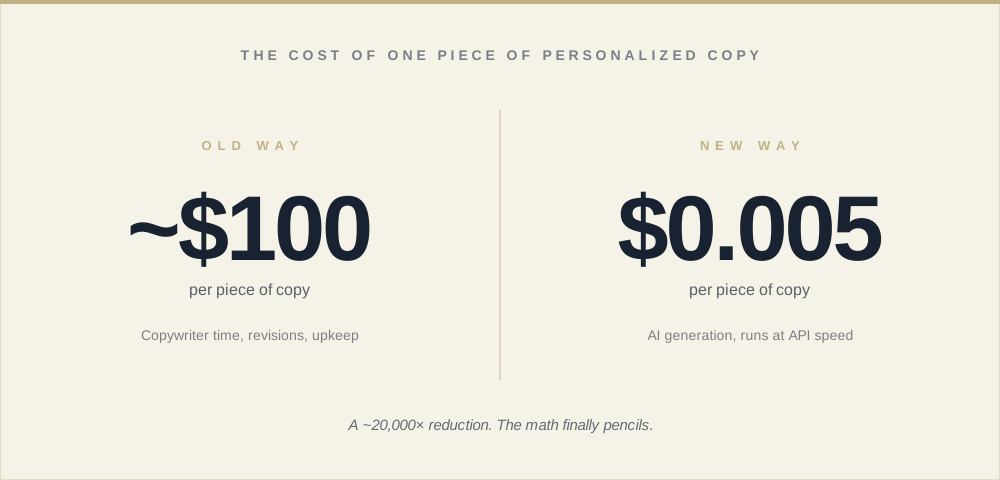
The squeeze isn’t hard anymore.
This is the part most ESPs are still catching up to. Klaviyo and the rest keep shipping features they label “AI” that are really just better variable swaps — pull the last-purchased product into a subject line, surface a recommended SKU. That’s not the unlock. The unlock is the copy itself changing per recipient.
So we built it
We’ve always built the tools we wished existed for our clients. The Flow Builder, the Audience Builder, the Klaviyo Bill Reducer — each one started as something we needed for a client account and turned into something we could give away. SendPersonal is the same instinct, sharper.
It connects to Klaviyo (purchase history, profile attributes, RFM) and Shopify (catalog, descriptions, categories). An AI engine sits between them and writes per-recipient copy — not template fragments, not subject-line swaps. Actual sentences that respond to what a specific person has done with you.
Setup takes about five minutes. OAuth into Klaviyo, answer a handful of questions about your brand voice, preview a batch of personalizations, approve them, and the copy flows back into Klaviyo as a custom property your existing emails can pull into a dynamic block. No flow rebuilds. No new template system. It plugs into the work you’ve already done.
A generic winback looks like this:
Hi {{first_name}}, we miss you! Here’s 15% off your next order.
A SendPersonal winback for the same lapsed customer looks like this:
Mara — last summer you grabbed the linen midi in size 6, then the matching belt a week later. We just got the same dress in oat and bone. If those aren’t your colors, the cropped denim you were eyeing last month is back in stock too. No discount this time — just thought you’d want to know.
The second one knows what she bought, in what size, when, what she browsed since, and what’s newly back in stock that fits the pattern. It reads like a person noticed. That’s the difference, and it shows up in the numbers.
On data: nothing is shared with third parties, nothing is used to train AI models, and the whole pipeline runs inside Amazon’s cloud infrastructure. That matters when you’re piping order data through.
Where this goes
A few things become true if this bet is right.
Templates become inputs to AI, not the output your customer ever sees. You define a brand voice, a set of constraints, the kinds of things you’d want said in a given moment — and the AI writes the actual sentences that go out.
Marketers shift from copywriters to editors and approvers. The job stops being “draft 20 variations” and starts being “say yes or no to what got drafted, and tell the system what was wrong when you say no.” That’s a better job, for what it’s worth — more strategic, less repetitive.
The brands that win retention are the ones that use the purchase data they already have at the copy level — not just the segment level. They already have everything they need. The question is whether they wire it through to the words their customers actually read.
The brands that lose are still segmenting on “engaged last 30 days” and writing the same email to all of them.
The mass broadcast was a fine workaround for the constraints we were under. Those constraints are gone now. The workaround should be gone too.
If you want to try it
If you want the technical view — what data to pull, how to structure the prompts, where it breaks — the first post in this series walks through it end to end.
If you’d rather we wire it into your flows for you, book a call. We do the integration, the brand-voice setup, the QA pass before anything goes out.
Otherwise, go try it. The first 1,000 personalizations are on us.
Try SendPersonal
Hook it up to a single flow, send a real campaign, see what happens. First 1,000 personalizations are free.
— Andrew
